AI & Humanities
AI Can Do More Than Chat: It Is Starting to Get Real Work Done
Why DeepSeek Harness is the focus of our second session, and why WorkBuddy is next.
By Quwei Ye (Tree Ye) | Event: August 30, 15:00–17:00 | Venue: JinShang Chengxi
Why I Want to Talk About DSH
Many of my friends already use Doubao, Kimi, DeepSeek, or ChatGPT. These tools make it easy to draft a piece of copy, explain a concept, or organize materials. But as soon as a task becomes a little longer, we fall into a familiar pattern of busywork: AI gives an answer, and we copy it; it forgets the context, and we explain it again; it finds the wrong sources, and we search again. Once the briefing is written, we move its contents into a PowerPoint presentation, then into an action plan.
AI appears to be doing the work, while a person sits beside it, serving as a human relay station. We have not really handed over the task; we have simply found another way to accompany it through the work.
That is precisely why I chose DeepSeek Harness, or DSH, as the topic for our second session. It is an open-source framework for AI agents, known as an agent harness, rather than another chat model. Here, an agent is an AI system that can plan and complete a task involving several steps; the harness brings models, tools, files, and permissions together into a workbench that can actually get things done.
“The Bachelor” and “Standing Out from the Crowd”
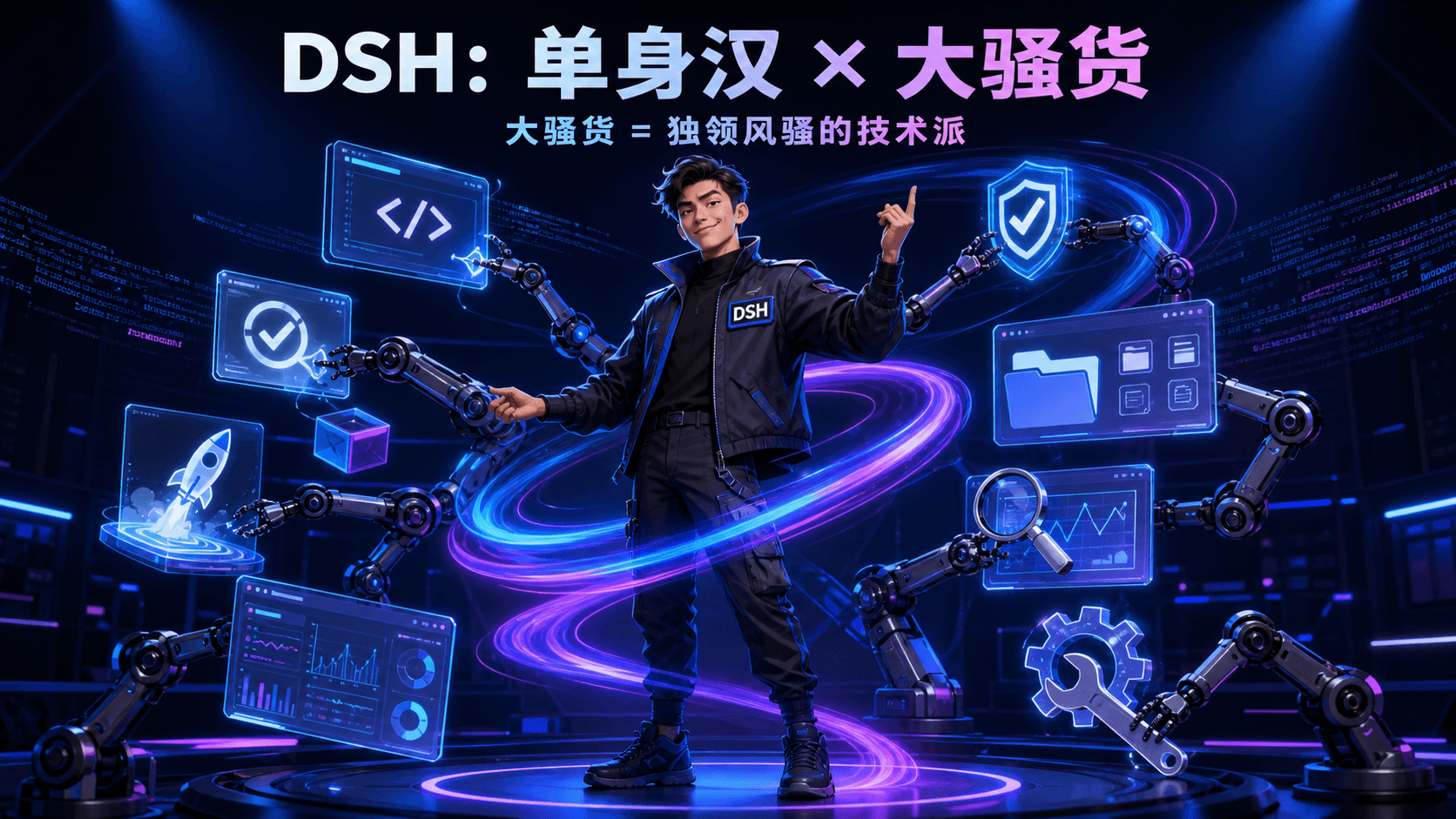
Friends in the community have given DSH a wonderfully evocative nickname: “the bachelor,” a play on its initials in Chinese. It is hardly a technical description, but it paints a vivid picture: a system that aims to carry a stretch of work through to completion without a person constantly copying, pasting, and nudging it along. More mischievous friends also play with the three letters, calling its restless inventiveness a kind of “flair.” I use the word here only in the sense of standing out from the crowd: models can be swapped, tools can be added, methods can be retained, and the process can be reviewed.
I prefer to put that flair into four plain statements: the system is yours; models are interchangeable; capabilities can be combined; and the process can be inspected. Everyday users do not need to memorize a string of technical terms first. Understanding these four statements is enough.
Combining Capabilities: Four Terms to Understand First
DSH’s official description sums up this design as “Everything is a plugin. Every run is traceable.” A plugin does not mean that installing more of them automatically makes the system smarter. It is a way to install, replace, and combine capabilities to suit a task. A kitchen full of knives does not automatically make anyone a master chef.
Of course, the system repeatedly plans, acts, and checks its work internally, while its interface allows people to observe and intervene. But participants do not need to begin by memorizing terms such as loop or UI (user interface). Learning how to assign a task, follow its progress, and evaluate the result matters more.
What is truly worth preserving is our own way of working, rather than an ever-growing collection of prompts. When a set of criteria for judgment is written as a Skill and paired with suitable models, tools, and safety boundaries, personal experience starts to become a productive resource that can be reused, inspected, and improved.

This Time, We Will Complete Just One Task
To help friends without a technical background really experience the difference, this session will not attempt an exhaustive tour of features. We will work with a situation that office workers know well:
At the session, we will first ask DSH to understand the goal and make a plan, then carry out five connected steps in the same practice folder:
- Verify public information from the past year and produce a traceable list of evidence;
- Condense the material into a decision briefing of no more than 800 Chinese characters;
- Turn the briefing into an outline for a six-slide presentation;
- Turn the recommendations into a plan for a small-scale, 30-day pilot;
- Finally, check its own files, length, links, and unfinished items.
What we really want to see goes beyond how quickly AI can write. Can it keep moving the work forward? Can files from one stage flow naturally into the next? Can its sources be traced? Will it acknowledge a missing capability? And will the final result be easy for a person to review and accept?
What Does DSH Actually Change?
An ordinary chat AI mainly returns a passage of text. DSH connects AI to a specific working folder, allowing it to read materials, create files, search for information, and keep advancing a task within the scope of its authorization. A harness can be understood as a working framework: it connects a model that can reason with tools that can act.
Everyday participants do not need to start by studying all the operating modes. In the second session, we will use only the default way of working and focus on whether it can complete a continuous task in one working folder. The session should not become an examination in technical vocabulary.
More crucially, we can review the important steps: which materials it read, which tools it called, and which files it created or changed. We can look beyond the final answer and ask, “How did it arrive at this result?”
Why DSH Is Not Needed for Every Task
I like DSH a great deal, but I do not think everyone should use it for every task. A mature approach to tools means recognizing when the extra effort is not worthwhile, rather than assuming that every new tool means all the old ones should retire.
An Easier Way to Begin: Tencent WorkBuddy
WorkBuddy is Tencent’s AI workbench for a broad range of office tasks. Users can describe a task in everyday language and let it read local files, organize materials, and produce reviewable deliverables such as documents, spreadsheets, PowerPoint presentations, and research reports within the permissions granted. It also offers several built-in models and allows users to configure custom models through its interface.
Both WorkBuddy and DSH are moving AI from answering questions toward completing tasks, but they take different routes. DSH is more like a laboratory that can be taken apart, studied, and modified. WorkBuddy is more like a fully fitted smart office, ready for you to move in.
DSH and WorkBuddy: Two Ways In, Rather Than a Contest
We do not have to choose one and reject the other. I chose DSH for the second session because it makes an especially useful teaching example for understanding AI agents. WorkBuddy is being considered for the third because it is better suited to helping everyday users quickly experience a complete office task from assignment to delivery. DSH is still in Developer Preview, while WorkBuddy’s models, credits, and plans may also change. In both cases, users should consult the official information current at the time of use.
Installation for Beginners
During this event, we will guide everyone through installation step by step. To keep the command line from taking over the entire session, we will give priority to prepared ZIP packages, illustrated guides, and one-click launch instructions. The command-line method will serve as a backup and also help participants understand how the system runs on their computers.
- Install Node.js, the basic runtime environment required by DSH. Use the version specified in the preparation checklist and the official requirements on the day of the event.
- Create a practice folder containing no private information or confidential workplace material, then open PowerShell or Terminal in that folder.
- Run npx @deepseek-ai/dsh web to start the local web interface.
- Open the model settings and enter an API Key, the credential used to access the model service. Do not forward the key to anyone, and never display it while sharing your screen.
- Select a Workspace (working folder), create a task, and begin with a minimal file operation.
If the computer goes to sleep or the DSH process is closed, the local task will stop too. To “assign a task before bed and wake up to the results,” both the computer and the process must keep running. Sustained execution over longer periods becomes possible only when it is deployed on a server that stays online. This detail may be less romantic, but it matters: a good tool can stand an honest explanation.

Beyond the Technology, I Care Most About the Human Role
The first salon’s theme was “Bringing Our Right to Think Back to the Table.” In the second session, we are giving AI a table at which it can do real work, without handing our thinking back over to it. The two aims fit together.
AI can handle searching, organizing, converting, repetitive execution, and preliminary checks of its own work. But people must still decide whether a problem is worth addressing, whether evidence can be trusted, where the boundaries lie, and who bears the consequences of errors. The more independently technology can act, the less we can let responsibility dissolve into the phrase “AI did it.”
So I hope participants will leave with more than a way to install DSH. I hope they will also take away a new form of AI literacy: the ability to delegate as well as ask questions, to evaluate deliverables as well as generate them, and to know when to press pause as well as pursue efficiency.
Three Salons: A Learning Path, Rather Than Three Tools
We hope to connect the three sessions step by step: first, learn to converse with AI; next, understand how AI acts; finally, turn AI into a real working partner.
- Session One | How People and AI Converse: Learn to record, ask follow-up questions, and reflect, bringing our right to think back to the table.
- Session Two | Why AI Can Act: Complete a continuous task with DSH and understand how the workbench, tools, methods, and safety boundaries work together.
- Session Three | How Everyday Users Can Have an AI Working Partner: Complete a real office deliverable with WorkBuddy and learn about delegation, supervision, acceptance, privacy, and responsibility.
Preview of Session Three: When AI Becomes an Office Colleague
The proposed topic for the third session is WorkBuddy. We can provide a set of disorganized meeting or event materials and ask participants to assign tasks in everyday language, ultimately producing meeting minutes, an action list, and a short report. The focus will be on learning how to express requirements clearly, check progress along the way, and judge whether the result is ready to use, rather than on whose files look the fanciest.
When AI becomes an “office colleague,” the hardest part is often deciding what to entrust to it, what to retain, and who is responsible for the final result, rather than simply getting it to start work. A tool can work overtime for us, but it cannot take the blame for us. People and AI would do well to settle that point in advance.
Beyond the Headlines: How We Choose Topics for the AI and Humanities Salon
The AI and Humanities Salon should not become a product launch, nor should it pretend that emerging trends are invisible. My approach is to follow what is happening without merely recycling trending stories, and to discuss tools without turning people into tools. Each topic must meet at least five criteria.
- Relevance: Pay attention to new tools, ideas, and questions that are emerging and worth understanding. DSH is attracting considerable attention, making it a suitable starting point for the second session.
- Humanistic Value: Go beyond how to use a tool to ask why we use it, whom it serves, and what should never be handed over to AI, connecting guiding principles, methods, and practical techniques.
- Usability: Give priority to tools that are accessible in China, relatively easy to use, and affordable for most participants, while taking safety and compliance into account.
- Demand: Adjust topics in response to feedback from participants, peers, and partners so that the sessions address real needs in work, learning, and everyday life.
- Learning Path: Make each session accessible on its own while connecting it to the topics before and after it, gradually building a series that moves from understanding and experience to application in new contexts.
From a Single Event to Three to Six Stages of Shared Learning
In the future, a good tool or a good book need not be covered in just one session. Three sessions can take participants through understanding, experience, and application. Six can add design, evaluation, and transfer to new contexts. This allows the salon to stay fresh without starting from zero each time, eventually forming an AI and humanities learning series that accumulates knowledge, supports reuse, and keeps growing.
Event Information
Three Things to Prepare Before You Come
- A laptop on which you are permitted to install software, together with its power adapter;
- The appropriate version of Node.js installed according to the preparation checklist, with a working network connection available;
- A valid model API Key and a practice folder containing no private information or confidential workplace material.

Speaker | Professor Quwei Ye (Tree Ye)
Where University Leadership, Education, and AI Meet the Humanities
Professor Ye has worked in university teaching, administration, and evaluation for more than forty years and is currently a professor at Beijing Hospitality Institute of Beijing International Studies University. He previously served as vice president of Peking University Founder Education Group and as president of two universities. He was a visiting scholar at Connecticut State University in the United States, studying Knowledge Discovery and Data Mining (KDD). He earned his master’s degree at the National University of Defense Technology, with a research focus on artificial intelligence and expert systems, and has visited more than twenty overseas universities for academic exchange and study. His longstanding interests include university strategic management, smart education, digital teaching, faculty development, and educational evaluation.
In recent years, his research has focused on integrating generative AI and AI agents with Problem-Based Learning (PBL), Project-Based Learning (PjBL), and Social and Emotional Learning (SEL). He developed and launched the AI-powered PBL Teaching Design Multi-Agent System (AIP-TDA-MAS 2.0), while continuing to explore how AI can support personal record-keeping, learning, reflection, and creation.
Years of university leadership have given him an organizational perspective; teaching and evaluation have brought an educational perspective; longstanding interests in literature, history, philosophy, painting, and seal carving have offered a humanistic perspective; and cross-cultural experience has provided another mirror. The AI and Humanities Salon brings these experiences together, discussing both how technology works and what kind of life it ought to serve.
Contact the Speaker
WeChat ID: tree_ye1961 | Personal website: www.treeye.cn
The Setting | JinShang Chengxi
AI and Humanities Workshop and Salon | Bringing Space, Reading, and AI Together Is Itself an Act of Course Design
Founded in 2016 by interior designer Lilian Tian, JinShang is a community-oriented space brand connecting work, events, dining, art, and lifestyle. According to JinShang’s official materials, it currently operates five locations in Beijing: JinShang Li, JinShang Yuan, JinShang Dongshanshu, JinShang Chengxi, and JinShang Mutianyu.
JinShang Chengxi is located at 34 Xinjiekou Outer Street, Xicheng District, Beijing. It offers a collection of cultural spaces for reading, conversation, reflection, and creation, beyond a standard meeting room. Chengxi Courtyard is suited to small meetings and tea gatherings; the Xiyan Reading Space brings books and conversation together; and Chengxi Theater hosts lectures, theater, and public cultural events.
AI and Humanities Workshop and Salon
I lead the AI and Humanities Workshop and Salon, providing frameworks, cases, and on-site guidance, but it is not a conventional one-way lecture. We prefer to call those who attend “participants” or “learning partners”: everyone brings their own experiences and questions, and we develop understanding together through dialogue, verification, and practice.


Contact and Registration
Speaker’s WeChat ID: tree_ye1961
Event registration: Open WeChat and scan the JinShang mini-program code below. Successful registration is subject to the confirmation page in the mini-program or a notification from the organizer.

A Final Thought: Delegate the Execution, Retain the Responsibility
AI is moving from being able to talk to being able to act. This promises enormous gains in efficiency, while also amplifying risks involving errors, permissions, and responsibility. We need neither fear nor idolize it. The best approach is to install it ourselves, personally entrust it with a task, carefully evaluate a deliverable, and then form our own judgment.
On August 30 at JinShang Chengxi, we will first find out together just how capable this “bachelor” is, and why it can stand out from the crowd. In the next session, we will bring WorkBuddy to the desks of everyday users. The question running through all three sessions remains the same: as AI takes on more and more of my work, what kind of person do I want to become with the time it frees up?
JinShang Chengxi | AI and Humanities Workshop and Salon
Technical References, Product Information, and Image Sources
Technical and product information was verified as of August 24, 2026. Both DSH and WorkBuddy continue to evolve. Installation procedures, interfaces, models, and plans should follow the official materials and hands-on checks available on the day of the event.
DeepSeek Harness official website: View source
DeepSeek Harness official GitHub repository: View source
DSH Web UI quick-start guide: View source
JinShang Chengxi official introduction: View source
Illustrated report on the spaces at JinShang Chengxi: View source
Illustrated report on Xiyan Library: View source
Tencent WorkBuddy official product page: View source
Tencent WorkBuddy official overview: View source