AI & Humanities · User Experience
“Your Answer Is Simmering. I’ll Serve It When It’s Ready.”
The human touch in AI’s waiting messages
The Human Touch in AI’s Waiting Messages
Quwei Ye (Tree / Shuye)
1. A few seconds of waiting, and someone on screen is making me laugh
Recently, I was using WorkBuddy for a slightly longer task and watching the screen for the result. Before the answer appeared, a succession of waiting messages had already made me smile.
“Overworking my brain. Workers’ compensation claim submitted.”
“Generating a reply | Compressing the waffle.”
“Caffeine is in place. Deep thinking begins.”
“Unleashing my special move.”
“Contemplating life—and your question while I’m at it.”
Over the following days, I came across a few more:
“Converting anxiety into productivity.”
“My thoughts are stuck in traffic. I’m directing the flow.”
“Inspiration has arrived and is checking in.”
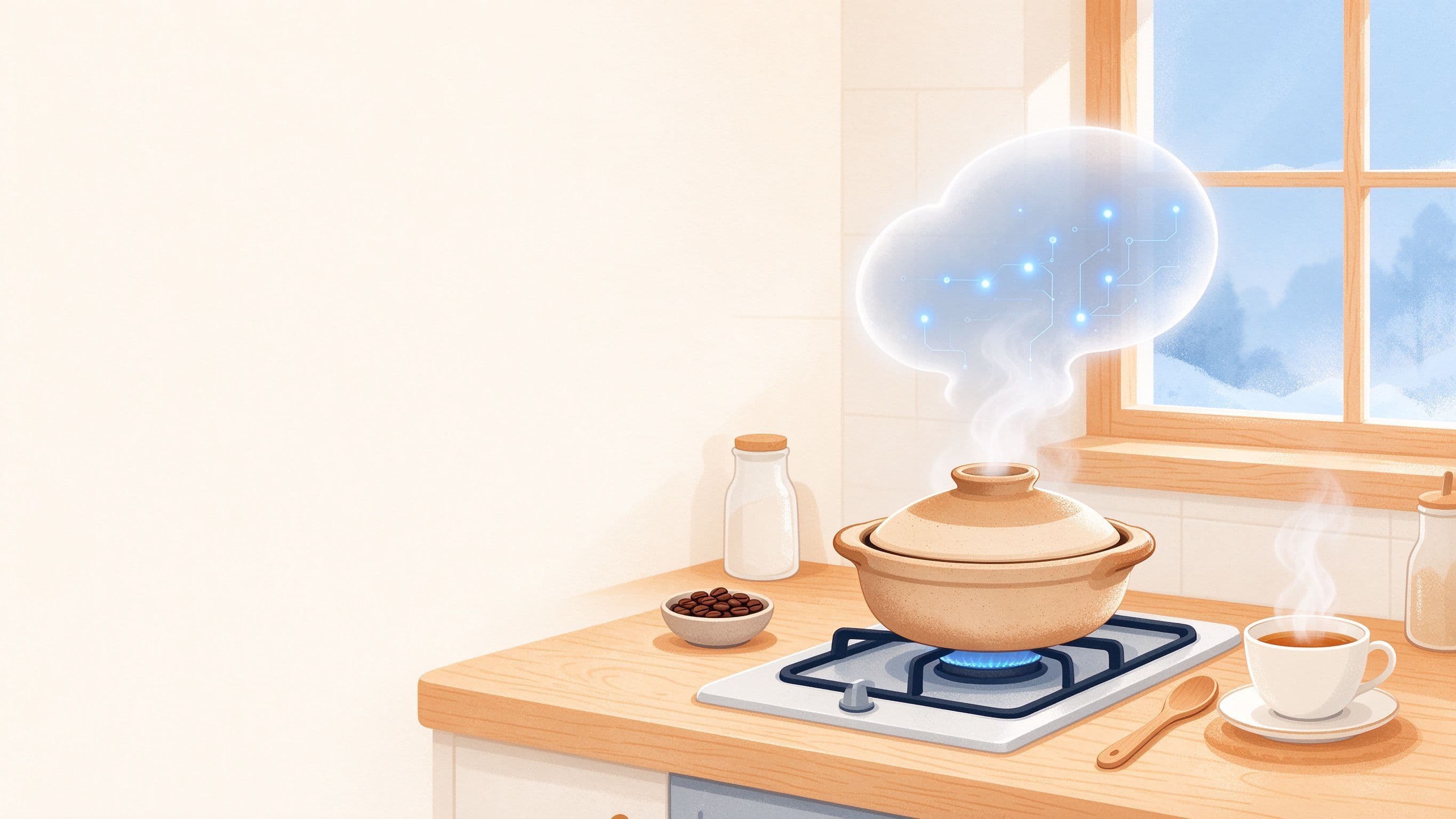
“Your answer is simmering. I’ll serve it when it’s ready.”
I began to wonder: who, exactly, was saying these things?
2. Is the AI saying this itself?
My first reaction was that the model had quite a sense of humor. But on reflection, something did not add up. Across different tasks and at different times, the same set of sentences kept appearing, with no connection to what I had asked it to do.
I later learned that these sentences were not generated by the large language model. Product developers had written them in advance and stored them in a library of interface copy on the client, to appear randomly or in rotation while a task was running. Product design has a name for this: UX writing, a part of interaction design.
We need to distinguish two kinds of text on the screen. One is fixed waiting copy: lines written by developers, independent of the underlying model. The other is the displayed thinking process (“Thinking”): reasoning text generated in response to the particular question, which varies from one task to another.
A simple way to tell them apart is to see whether the exact same sentence appears for a different task or account. If it does, it is a prewritten line. If it closely analyzes the details of your current question, it is language generated by the model.
3. Why write jokes for a machine?
It is only a loading animation. Why put so much thought into it? I can see at least three reasons.
First, to make the wait feel shorter. Psychology uses the term “perceived waiting time”: the experience of waiting does not necessarily match the time on a clock. A dozen seconds watching a spinner can feel like a minute; the same time, with changing lines to read, passes in a flash.
Second, to give the machine a persona. These sentences make the AI feel like a colleague sitting across from you: a little cheeky, but working hard. In product design, this is a way of creating a persona.
Third, and most striking to me, the words help hold your emotions. “Converting anxiety into productivity”: the person waiting is anxious, and a self-deprecating joke seems to take some of that anxiety on their behalf. “Contemplating life—and your question while I’m at it”: it pretends to be taking the matter even more seriously than you are, and the joke releases some of your tension.
4. Everyday warmth: translating computation into human language
Reading these lines together, I noticed something interesting: almost all of them borrow from ordinary human life.
To describe computation, it says “Caffeine is in place” rather than “Calculating”—the language of someone working late. To describe organizing its thoughts, it says “My thoughts are stuck in traffic. I’m directing the flow” rather than “Processing”—the language of someone on the road. To describe generation, it says “Your answer is simmering. I’ll serve it when it’s ready” rather than “80% complete”—the language of someone cooking. To describe an idea arriving, it says “Inspiration has arrived and is checking in” rather than “Retrieval complete”—the language of a hotel guest.
These lines translate the machine’s invisible, cold, instantaneous computation into human labor: work with a body, a sense of time, and the warmth of everyday life.
This is an act of translation: people teaching AI to speak in human terms. Doing it well calls for observation and consideration for other people’s lives, beyond the algorithm itself.
5. Why do we laugh?
There are two layers to the answer.
The first is incongruity. A machine is supposed to be precise and composed, yet here it is solemnly filing a workers’ compensation claim. The mismatch creates the humor.
The deeper layer is that we know there is a person behind the screen: a product manager, writer, or designer who sat at a desk and carefully wrote these apparently “useless” lines. Instead of leaving us alone with a cold progress bar, they arranged a little company for the person waiting.
Waiting can be a lonely activity. A playful sentence turns it into something shared by two people.
6. An educator’s reflection: understanding the script is a form of literacy
This made me think of the classroom.
When discussing AI literacy within digital literacy, we often emphasize asking good questions and judging the answers. These waiting messages remind us of another skill students need: telling which words on a screen were generated by AI and which were written by people for AI.
I designed a small classroom exercise: imagine that you are an AI product designer and write three waiting messages for a loading screen. This calls for an ability alongside good questioning: expression and empathy. To write a reassuring sentence, you first have to understand the unease of the person waiting. The last mile of technology is language.
I also tried writing a few in the same spirit—my own homework submission:
“Every brain cell is in an all-hands meeting. Nobody has taken leave.”
“Your answer is queuing for security screening. Please stand by.”
“Loosening the soil around my thoughts so a conclusion can sprout.”
“Your tea is served. The answer will be along shortly.”
“Still shaking hands with your question. Haven’t let go yet.”
“The progress bar is out for a morning run. Already out of breath.”
(These six lines were written by the author as examples for a classroom exercise. They are not original product messages.)
7. Record, reflect, question, act: turning an observation into experience
This small observation also fits the six-part cycle I often discuss: Record, Reflect, Question, Act, Review, and Transform. I recorded the sentences on the screen (Record), considered where they came from (Reflect), asked “Why was it designed this way?” (Question), and then wrote a few myself as a small practical experiment (Act). In this way, a technological observation becomes experience that can be carried into another setting.

8. In the gaps of technology, the humanities may be a seemingly useless sentence
We tend to think of technology and the humanities as separate things. Yet look at what happens: at precisely the point where an advanced intelligent system makes us wait, it offers a bit of chatter, a joke, and a touch of everyday warmth.
The next time an AI makes you wait, try reading those lines to the end. A smile is a greeting exchanged across the distance between you and the person who wrote them.
The answer is simmering. When it is ready, it will find its way to your table.
— · —
About the author
I hope that learning to use AI tools can accompany human growth: completing practical tasks while explaining the evidence, judging where a tool is appropriate, and turning what one practice teaches us into a capacity for the next action.

Personal website: www.treeye.cn | WeChat: tree_ye1961 | Email: shuye_1961@qq.com
Meeting at JinShang
Founded in 2016 by interior designer Lilian Tian, JinShang is a community space brand connecting work, events, dining, art, and everyday life.
JinShang Chengxi is at No. 34 Xinjiekou Outer Street, Xicheng District, Beijing. The Chengxi courtyard provides a setting for small conversations and tea gatherings; the Xiyan reading space brings books and dialogue together; and the Chengxi theater hosts lectures, theater, and public cultural events. These different settings make room for reading, exchange, reflection, and creation.

By bringing the AI Humanities Salon here, I hope we can understand the technology while discussing its relationship with life, learning, and work. Through shared practice, we can give serious attention to the questions each person brings.