16.1
Test What Graph Structure Actually Contributes
Future work should isolate graph structure from accompanying improvements. One testable hypothesis is that typed relations with correct identity help cross passage questions more than the same entity names alone. Fix sources, generator, and context budget, then compare real relations, random relations, no relations, and manually annotated reference relations. If the real graph adds little while the reference graph helps, construction may be the bottleneck. If neither helps, the questions may not need structure or the generator may not use it.
This design explains more than simply adding a graph module. Grouping by path length, ambiguity, and relation rarity can identify useful conditions. Random controls should preserve density to avoid context length confounding. Reference graphs need annotation cost rather than being treated as free. Successful and failed evidence paths should accompany scores so readers can inspect whether connections are reasonable. Graph value need not appear on every task. Identifying the subset that benefits and using simpler retrieval elsewhere is itself a practical research result.
16.2
Propagate Uncertainty into Summaries and Answers
Uncertainty can disappear through successive summaries: possible statements become affirmative observations, and disagreements disappear inside community reports. Research should propagate knowledge states through dependencies rather than append vague caution at the end. Observations can retain support, opposition, and unknown conditions; summaries can preserve disagreement; answers can be checked for equivalent boundaries. Model probability, source reliability, and evidence completeness are different quantities and should not be multiplied as if they shared one interpretation.
A testable hypothesis is that explicit states and dependencies reduce unwarranted certainty on conflicts without excessive abstention. Experiments need consistent, conflicting, temporally changing, and incomplete cases, measuring both correct judgments and justified answer scope. Compression should be tested for minority evidence retention. Presentation research can compare concise state labels, parallel sources, and expandable evidence to balance clarity with reading burden. Good uncertainty communication identifies supported conclusions, unresolved conditions, and evidence that could change judgment, rather than merely repeating words such as perhaps.
16.3
Study Modality Necessity and Evidence Sufficiency
Multimodal GraphRAG needs a stricter question than whether it accepts images: which questions require them and which regions change answers? Modality necessity can become an annotation field explaining whether text suffices, what vision contributes, and whether alternative evidence exists. Compare complete input, removed vision, and incorrect vision. Stable answers without images may mean text is sufficient or the model ignored vision; scores alone cannot distinguish these explanations.
Evidence sufficiency can be studied through minimum support sets. Which observations jointly support a claim, which provide background, and which challenge it? Graphs can encode these roles while generation preserves crucial combinations under budgets. Experiments can measure quality as evidence is removed rather than testing only one fixed top count. Video and complex pages also require spatial and temporal necessity analysis. The goal is sufficient and necessary evidence, not permanent participation of every modality. This can reduce cost, improve explanations, and limit distraction from irrelevant images or redundant paths.
16.4
Dynamic Knowledge and Longitudinal Evaluation
Static tests rarely establish reliability after months of operation. Longitudinal studies can introduce new records, revisions, and withdrawals over time, repeatedly querying historical and new questions. Measures include change to availability delay, continued citation of invalid evidence, accumulated false merges, and recurrence after repairs. Complete versions are essential to reconstruct what information was available when an answer was produced and evaluate it fairly.
Studies should also measure maintenance rather than only automation. Human review, rule changes, and incident work may dominate costs. Full rebuilds, local updates, and delayed updates can be compared under one change sequence. Data drift and software upgrades should be recorded separately instead of combined into one before and after comparison. Snapshot findings need temporal boundaries; claims of stability across updates need evidence across those updates. Dynamic evaluation moves GraphRAG from a one time indexing exercise toward a sustainable knowledge service, a central condition for durable application value.
16.5
A Staged Adoption Roadmap
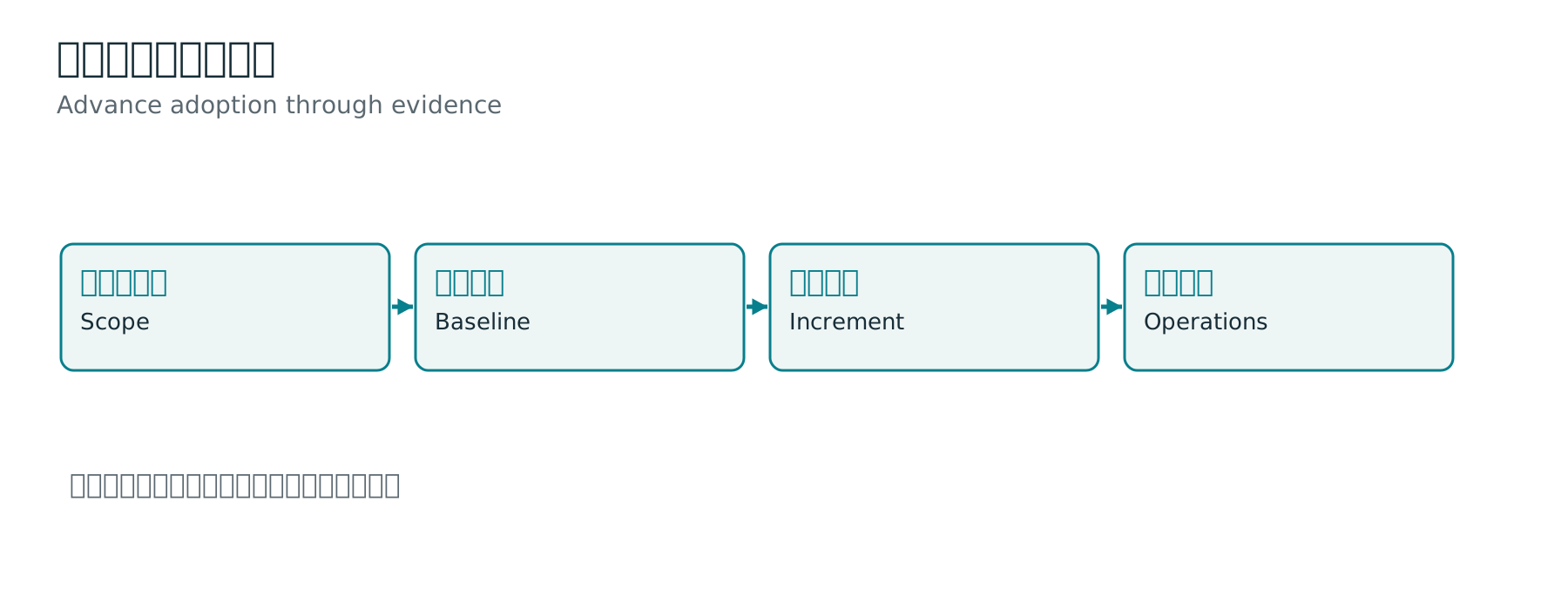
A roadmap can use four stages with exit conditions. First inventory sources and questions, permissions, and reference answers. Second establish reliable basic retrieval and citations and identify remaining errors. Third add structure only for relational, global, or visually necessary questions and compare under matched conditions. Fourth introduce updating, correction, and operational monitoring. Deliverables should be inspectable outcomes rather than completed modules. Progress should follow evidence and team capacity instead of a fixed calendar.
Before advancing, ask whether the addition improves target work, whether new failures can be detected and repaired, and whether maintenance has an accountable owner. Unclear answers justify narrower scope or further testing. Universities can translate the roadmap into paper, table, and code learning stages; enterprises into bounded pilots and expansion. Graph size, model parameters, and image counts do not replace acceptance results. Decision records should preserve choices, evidence, unresolved issues, and fallback routes so the approach can change with experiments. Mature adoption permits simplification rather than treating complexity itself as progress.
Original design
16.6
Connecting the Two Research Lines and the Final Assessment
The Microsoft and Meituan articles emphasize different sides of knowledge use and construction. The former shows how relationships and community hierarchies can support discovery in private narrative material. The latter shows how ingredient level multimodal information supports detailed dish understanding. Connecting them requires shared identity, evidence locations, versions, permissions, and evaluation, not simply adding multimodal to a system name. Graphs structure relations, modalities provide complementary observations, retrieval selects material for questions, and generation organizes expression. Errors at any layer can change the final judgment.
The synthesis is that GraphRAG and multimodal graphs are useful as testable research and engineering methods when questions require relational or visual evidence, sources are adequate, errors are traceable, and maintenance is sustainable. They do not automatically eliminate hallucinations, turn similarity into fact, or convert cooccurrence into causation. Persuasive applications provide more complete necessary evidence, clearer uncertainty, and more repairable processes for concrete tasks rather than the largest network. Future work should examine these observable outcomes and report conditions without improvement. That discipline connects technical progress to reliable knowledge work and substantive teaching practice.