11.1
Making a marketing funnel auditable
Marketing funnels commonly show exposure, visits, inquiries, bookings, and consumption. A funnel does not explain why losses occur. A defensible representation defines each event, time window, and denominator, distinguishing people, events, and orders. Repeated visits by one person do not automatically represent several potential guests, and a booking is not a completed stay. AI can help organize fields, while analysts confirm whether collection practices support the definitions.
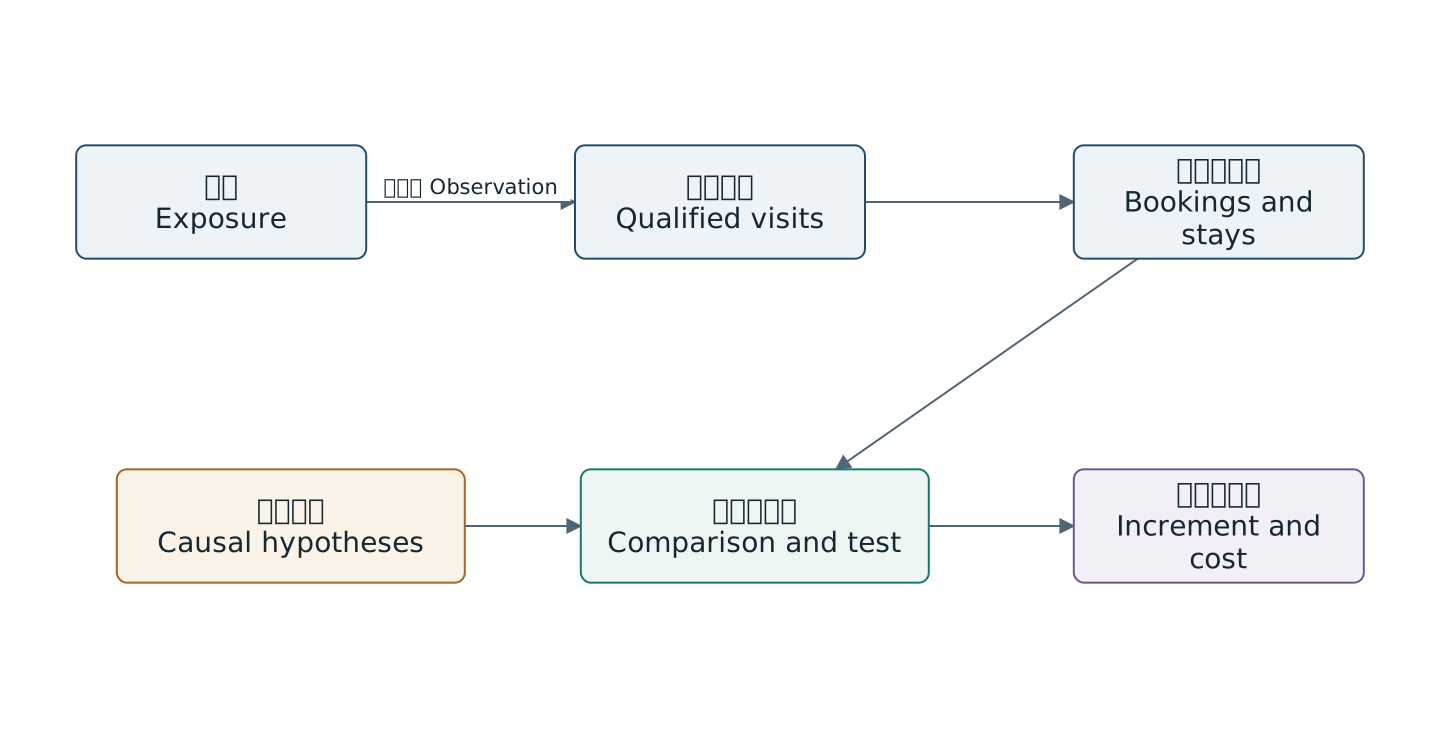
A synthetic classroom funnel might contain one hundred thousand exposures, five thousand qualified visits, two hundred bookings, and one hundred fifty completed stays. Under those definitions, visit-to-booking conversion is four percent and booking completion is seventy-five percent. These ratios do not establish the campaign's causal effect. There is no control condition and no exclusion of people who would have booked anyway. Students must identify additional evidence needed to estimate incremental stays.
Visual thinking first exposes inconsistent definitions and then separates observation from explanation. A data chart shows where a decline occurs, a hypothesis diagram proposes mechanisms, and an experiment investigates an intervention. These steps can connect, but they cannot be compressed into a persuasive growth-loop graphic that appears to prove everything. Stronger AI-generated marketing narratives increase the importance of checking these distinctions.
11.2
Boundaries of personas and journeys
AI can identify themes in interviews, reviews, and service records and organize them into journeys or need maps. Personas can nevertheless turn speculation into an apparently real person by adding unsupported age, income, motives, and emotions. A realistic portrait may conceal the fact that a persona is a working hypothesis. Observations, inferences, and unanswered questions should remain separate, with source excerpts supporting important needs and sample coverage made explicit.
Repeated comments about waiting after arrival provide a service clue. Inferring that the same group prefers an expensive package requires additional evidence. A journey can distinguish observed touchpoints, recorded emotional expressions, and team hypotheses instead of filling every cell. AI clustering and summaries may also underrepresent silent needs, minority experiences, or infrequent but severe failures.
Students can audit an AI persona by linking every attribute to evidence or labeling it as a hypothesis. After removing unsupported detail, they reassess what decisions remain justified. The exercise reveals the difference between detail and reliability. A better persona may look less like a complete individual while more accurately showing what is known and unknown.
Conceptual design proposed in this report
Figures retain bilingual labels; the surrounding text explains them. Open for a larger view.11.3
Cash flow and scenarios in tourism finance
A tourism-finance exercise can examine hotel refurbishment, seasonal operations, and project cash flows. Visual thinking places initial expenditure, operating receipts, fixed costs, maintenance, and financing on one timeline. AI can extract assumptions and draft scenario tables, while computational tools execute the model. This is an educational modeling approach rather than an assessment of any actual investment.
Returns and vulnerabilities should appear together. A project profitable under average conditions may still experience a seasonal cash shortfall. A high-revenue option may rely on unsustainable discounts. Base, optimistic, and stress scenarios should make assumptions visible instead of presenting one rising line. Students identify which variables come from evidence, which are chosen, and whether dependencies have been represented. Treating correlated variables as independent can distort an otherwise attractive scenario display.
A cash-flow timeline can precede calculations of present value or payback. Discount rates, taxes, financing, and residual values affect results, and different measures answer different questions. AI should provide inspectable parameters and formulas rather than a general declaration of feasibility. The assessed artifact is a model explanation containing assumptions, sensitivity, and counterexamples.
11.4
A shared dictionary across domains
Hotel operations, marketing, and finance use measures such as occupancy, conversion, cash flow, revenue, and profit. Without shared definitions, teams may connect incompatible quantities. A project dictionary should record names, units, temporal granularity, definitions, and ownership. Quantitative nodes refer to dictionary identifiers so that a changed definition can be checked across all related graphics.
Cross-domain work also needs to distinguish description, prediction, decision, and execution. Description concerns past observations. Prediction estimates future conditions. Decision compares objectives and constraints. Execution changes the world. AI can participate in each, but permissions and validation differ. Showing separate stages helps students understand the responsibilities between a forecast and authorized action.
A final defense can ask what judgment the representation changed, what evidence supports that judgment, and how the plan changes if an assumption fails. Industry cases then develop communication and responsibility alongside tool use. Visual thinking supplies shared structure, professional knowledge determines whether it is defensible, and AI lowers the cost of expression and comparison.
| Observation or model | Supports | Needs more evidence |
|---|---|---|
| Marketing funnel | Conversions under definitions | Incremental effect and cost |
| Customer themes | Recurring documented needs | Representativeness and unspoken needs |
| User journey | Touchpoints and hypothesized friction | Behavior and severity |
| Cash-flow scenario | Timing within assumptions | Parameter evidence and external change |
| Sensitivity chart | How input change propagates | Structural error and dependence |
| Action proposal | Candidates and testing route | Authority resources and field trial |