14.1
Turning attachment proposals into specifications
The attachments propose a progression from skills to expert roles and expert teams. This can organize production responsibilities, but the names do not guarantee competence or quality. A skill may contain reusable guidance, scripts, templates, or tools. An expert role is a configuration with a defined responsibility. A team is a collaboration workflow. These terms describe architecture here; they do not establish current support by a particular platform or confer professional qualifications.
Implementation requires inputs, outputs, constraints, dependencies, and acceptance criteria. A course-structure capability receives objectives and sources and produces relationships and activities. A drawing capability receives confirmed semantics and produces graphics and editable sources. A validation capability receives artifacts and evidence and returns specific findings. Merely describing a role as excellent leaves important behavior underspecified. Inspectable products should define responsibility.
Fixed attachment rules can become defaults with exceptions. A card-length limit can manage density while allowing expansion for difficult concepts. Slide counts can support planning without replacing lesson timing. Requiring a diagram can develop representation while preserving necessary prose, calculations, and accessible alternatives. Rules should stabilize quality rather than impose identical appearance on every lesson. Deviations need reasons.
14.2
Choosing a single workflow or divided roles
Not every lesson needs several agents. With limited sources and clear objectives, one model plus deterministic rendering and checks may be easier to manage. Tasks combining scholarly verification, industry cases, visual design, and assessment may benefit from differentiated responsibilities. More roles also increase communication, terminology, and conflict-resolution costs. Overall quality, time, and rework should determine the choice rather than the number of roles.
Four responsibilities are useful: course architecture for objectives and concepts, industry review for scenario validity, representation design for visual form, and quality review for sources, calculations, and assessment alignment. People and AI can share these responsibilities. Important review should use independent evidence and rules where possible so that shared assumptions do not simply receive repeated agreement. A course owner retains responsibility for interpretation and can trace important revisions.
The process should include returns. Industry review may change the problem definition, quality review may require a different representation, and student testing may overturn an activity plan. Rework routes specify who proposes a change, who confirms its effects, and which artifacts update together. Collaboration becomes an iterative process rather than an idealized one-way production line.
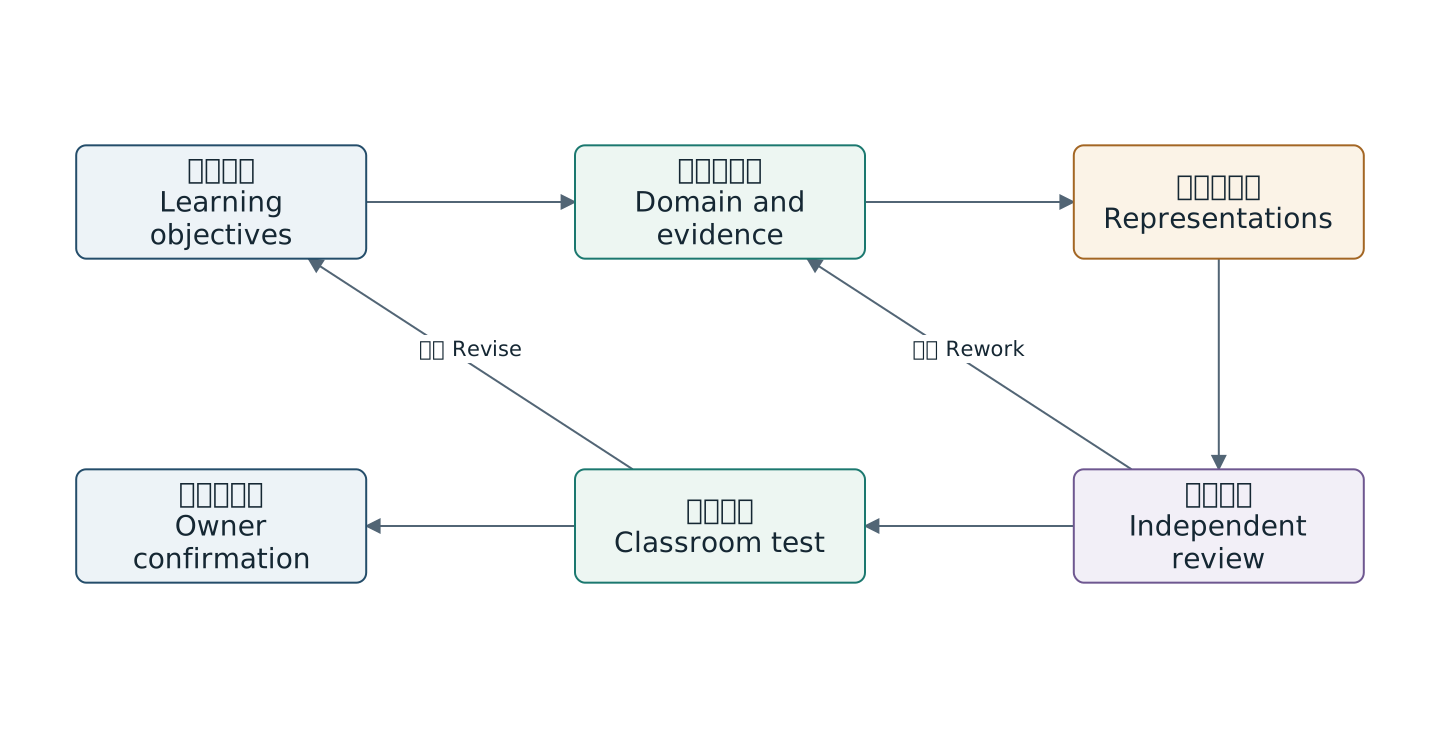
Conceptual design proposed in this report
Figures retain bilingual labels; the surrounding text explains them. Open for a larger view.14.3
Contents of a production contract
A production contract can contain five field groups. Objectives specify audience, prior knowledge, outcomes, and time. Sources specify provenance, validity, permission, and gaps. Structure specifies concepts, relationships, and reasons for representation choices. Deliverables connect slides, manuals, activities, and assignments. Quality fields define factual, readability, exception, and assessment checks. The contract can be concise while giving all stages one task definition.
Outputs also need states. A draft permits unresolved content. A reviewed version requires support for important relations. A classroom version requires a usable demonstration and fallback. An archive preserves sources and revisions. One final label should not erase these distinctions. States help determine what can proceed automatically and what needs judgment. A changed policy or interface can return related outputs to review.
Bilingual work needs terminology, shared identifiers, and numerical consistency. The Chinese term for returns or revenue can require different English words in different contexts. Labels, headings, and prose should follow variable definitions. Review must examine conditions, negation, and uncertainty as well as fluent grammar.
14.4
Testing whether efficiency actually improves
An efficiency study should record the entire cost, not only model-generation time. Separate source preparation, objective specification, candidate generation, human revision, fact-checking, visual review, classroom testing, and rework. Compare lessons of similar difficulty under common quality criteria and preserve a non-AI baseline. Initial template setup should be distinguished from repeated use. If layout time falls while verification rises, both belong in the result.
Quality needs independent measures such as important factual errors, incorrect edges, learner misconceptions, editability, and inconsistency across deliverables. Faster production with more serious errors is not a simple success. A conditional finding may be more useful: routine lessons become faster while difficult concepts still require substantial instructor involvement, or visual consistency improves while cases need additional checks.
A maintained error library can turn recurring failures into reusable checks: missing effective dates, causal arrows confused with sequence, or absent units. Checks should respond to observed errors rather than expand indefinitely. The system then accumulates tested working knowledge alongside prompts, with human participation concentrated where it adds value.
| Responsibility | Artifact | Acceptance |
|---|---|---|
| Architecture | Objectives concepts and activities | Activities demonstrate objectives |
| Domain review | Rules and scenario boundaries | Facts and authority clear |
| Representation | Graphics and source structure | Readable maintainable relations |
| Source review | Origins dates and scope | Important claims traceable |
| Quality | Findings and minimal repairs | Numbers languages and exceptions aligned |
| Course owner | Confirmed release | Own interpretation and updates |