12.1
Event Evidence Chains for Equipment Maintenance
The following scenarios are proposed blueprints rather than completed deployments. Maintenance can connect equipment, components, incidents, work orders, and manuals. Images document site conditions and text records operations and replacements. A question about repeated alarms first requires device identity and temporal scope, followed by related alarms, work orders, and component changes. The graph connects scattered evidence but cannot infer causation from sequence alone. Answers should distinguish recorded causes, engineer hypotheses, and unresolved associations.
Event modeling is central. An alarm is not a permanent property, and one error code can have different causes. Images need capture time and equipment identifiers to avoid confusing similar machines. Historical tasks can test complete record recovery and preservation of unresolved status, with engineers judging search time savings. Errors include merging devices, missing post repair versions, and treating temporary conditions as persistent faults. The system supports retrieval and preparation of inspection material; maintenance actions follow established professional procedures. Benefits should be measured through task time, omitted evidence, and error severity rather than expert sounding prose alone.
12.2
Product Support and Versioned Knowledge
Product support often has abundant material applying to different models, regions, and software versions. A graph can represent families, models, components, features, release dates, and applicability rules, with pages and screenshots as evidence. A feature question should establish the version before locating manuals and changes. Missing confirmation should produce uncertainty rather than inference from neighboring models or old screenshots. Visual material can identify interface locations and explain steps, but screenshots need version conditions too.
Paired questions about a feature changing across versions can test correct evidence assignment. Outdated documents, regional restrictions, and configuration exceptions test whether qualifiers reach the answer. Support staff should be able to inspect cited pages quickly. Graph structure helps locate compatibility, but compatibility is not automatically transitive. A product supporting a component and that component being related to another product do not establish mutual support. Rules need explicit types and scope. The main potential benefits are fewer inappropriate matches and less repeated searching, to be validated through actual support tasks rather than generic language quality.
12.3
Claims Methods and Evidence in Scientific Literature
Scientific literature can connect papers, datasets, methods, tasks, and experimental results. Comparing methods under different data conditions requires more than similar abstracts. A graph can link results to splits, metrics, models, and paper versions, helping researchers identify comparable evidence. Figure pages provide numerical context, text supplies qualifiers, and supplements may contain implementation details. Author reported results, independent reproductions, and a researcher's inferences should remain distinct rather than becoming equally confirmed edges.
Version and publication status are especially important. Preprint updates may revise experiments, while conference and extended journal papers can belong to one research series. Counting them independently exaggerates evidence. Citation centrality is not correctness: frequent citation may reflect foundational status, controversy, or history. Evaluation can ask a conditional comparison and require explicit comparable and incomparable aspects. Human review should inspect experimental units, metric directions, and missing results. Discovery tools improve access to material, while research judgment still requires critical reading of originals. This report follows that division when using Consensus and SciSpace for literature discovery.
12.4
Theme Discovery and Minority Views in Organizational Knowledge
Meeting notes, retrospectives, and internal reports often contain themes spanning documents. A question about recurring collaboration barriers requires multiple projects rather than one similarly worded note. Community reports can provide entry points, but synthesis should trace to sources and distinguish repetition, occasional mention, and insufficient evidence. Teams may interpret one event differently, and tidy themes should not erase disagreements.
Evaluation can ask knowledgeable reviewers to establish themes independently, then assess important discoveries, minority omissions, and overgeneralization from isolated incidents. Unequal document volume needs control: more talkative teams are not necessarily more representative, and repeated weekly reports do not create independent events. Theme summaries can report independent projects and temporal scope instead of only mentions. Permissions are critical because cross document combinations may reveal personal relationships. Management questions should also avoid unsupported attribution to individuals. The value lies in organizing clues and generating verifiable questions rather than replacing organizational investigation with automatic summaries.
12.5
Matching Boundaries in Supply and Product Relations
Supply and product records contain identical names with different specifications and different names for the same object. Multimodal graphs can combine packaging, specifications, identifiers, and supply records to propose matches, followed by explicit confirmation rules. Same product, same category, substitute, and accessory are different relations with different business consequences. Visual similarity helps discover candidates but cannot alone authorize stock merging or supply substitution. Versions, package quantities, and measurement units belong in identity decisions.
Hard negatives include one brand with different capacities, similar looking models, and redesigned packaging for the same product. Error costs are asymmetric: false merges can contaminate inventory and analysis, while missed matches create manual work. Thresholds should follow those costs rather than maximum aggregate accuracy alone. Review interfaces can show decisive differences and source evidence and preserve unresolved status. Graph structure may flag anomalies such as one identifier linked to incompatible specifications, but anomalies remain inspection clues. Success concerns false and missed merges, review time, and later corrections, not the appearance of an attractive network.
12.6
A Shared Evaluation Framework with Domain Specific Conditions
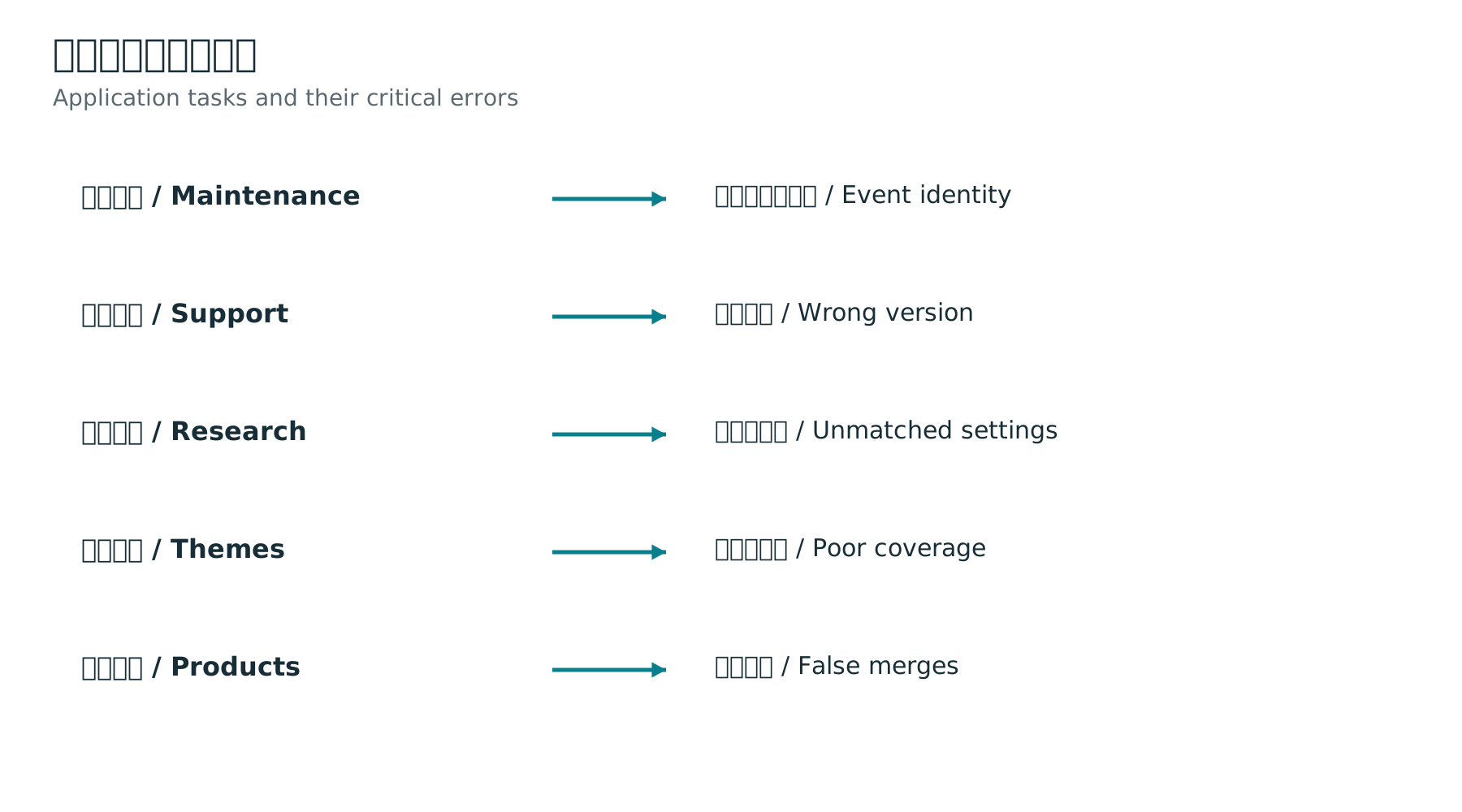
These applications share an evidence workflow: establish objects and time, locate sources, connect relations, preserve qualifiers, and generate verifiable outputs. Their correctness criteria differ. Maintenance emphasizes events and professional procedures; support version compatibility; research experimental comparability; organizations representativeness; and products identity. One generic benchmark can miss decisive errors. A common platform may share resource management, evidence interfaces, and auditing, while domains need their own ontologies, rules, and test sets.
Implementation should close the loop for one frequent task before expanding. Cross departmental reuse requires checking terminology, permissions, source ownership, and review capacity, not just copying code. Success in one department does not establish equivalent data conditions elsewhere. A scenario decision card can record users, question distributions, required evidence, critical errors, update frequency, owners, and stopping conditions. Such cards turn concepts into manageable experiments and provide a common language across domains. Value comes from fewer omissions and better decisions in concrete tasks rather than the number of models or databases adopted.
Original design