04.1
Objects Managed by the Graph Index
The official Microsoft GraphRAG dataflow distinguishes documents, text units, entities, relationships, communities, and community reports. These categories allow original material and derived structure to coexist. A graph index does more than replace a document with a few keywords: it links locatable passages to extracted objects and then organizes larger semantic structures. Figure 5 separates the source, structural, and summary layers so that the information added or potentially lost at each transformation can be examined. [R32]
In our analysis, preserving traceability among these objects is the first design requirement. An entity's name may change, and a document may later be segmented differently, but the evidence used by an earlier answer should remain interpretable. If an update overwrites the current graph without preserving versions, historical answers can become impossible to audit. A research experiment likewise needs a fixed corpus snapshot, segmentation scheme, and extraction version. Otherwise the supposedly identical collection used in a comparison may have changed. Evaluation of a graph index should therefore consider both query quality and the stability of identity across transformations. The latter rarely appears directly in a question-answering score, yet it determines whether the system can be maintained over time. A representation that produces an attractive demonstration but cannot explain which source version supports a relationship is incomplete for applications requiring accountability or reproducible analysis.
04.2
Entity Relationship Extraction and Information Compression
Language-model extraction provides a flexible entry point for unstructured material, but it is also a lossy transformation. Conditions, modality, exceptions, and time can disappear when a passage is compressed into a short relationship. Converting a report suggesting that a project might be delayed into a statement that the project was delayed removes the source, the inferential status, and the uncertainty at once. We recommend preserving the status of a proposition and its supporting passage, and testing extraction with negation, conditional statements, and reported speech. Compliance with an output schema does not establish semantic correctness. [R02][R32]
Extraction granularity should serve the query task. Retaining only frequent entities may remove a rare object that determines an answer. Turning almost every noun into an entity can instead produce a noisy graph that is costly to maintain. A study can vary the permitted entity types and relationship constraints, then examine their effects on recall, error propagation, and indexing cost. A generator may also insert general knowledge into an extraction output, so important relationships should be checked for support in the current collection. We argue for storing model-proposed candidates separately from relationships that have passed an evidence check. Extraction then becomes an auditable process of knowledge construction rather than an irreversible rewriting of text. This distinction enables targeted correction and lets an application use more permissive candidates for exploratory retrieval without representing them as confirmed facts in a final answer.
04.3
Community Hierarchies and Theme Representation
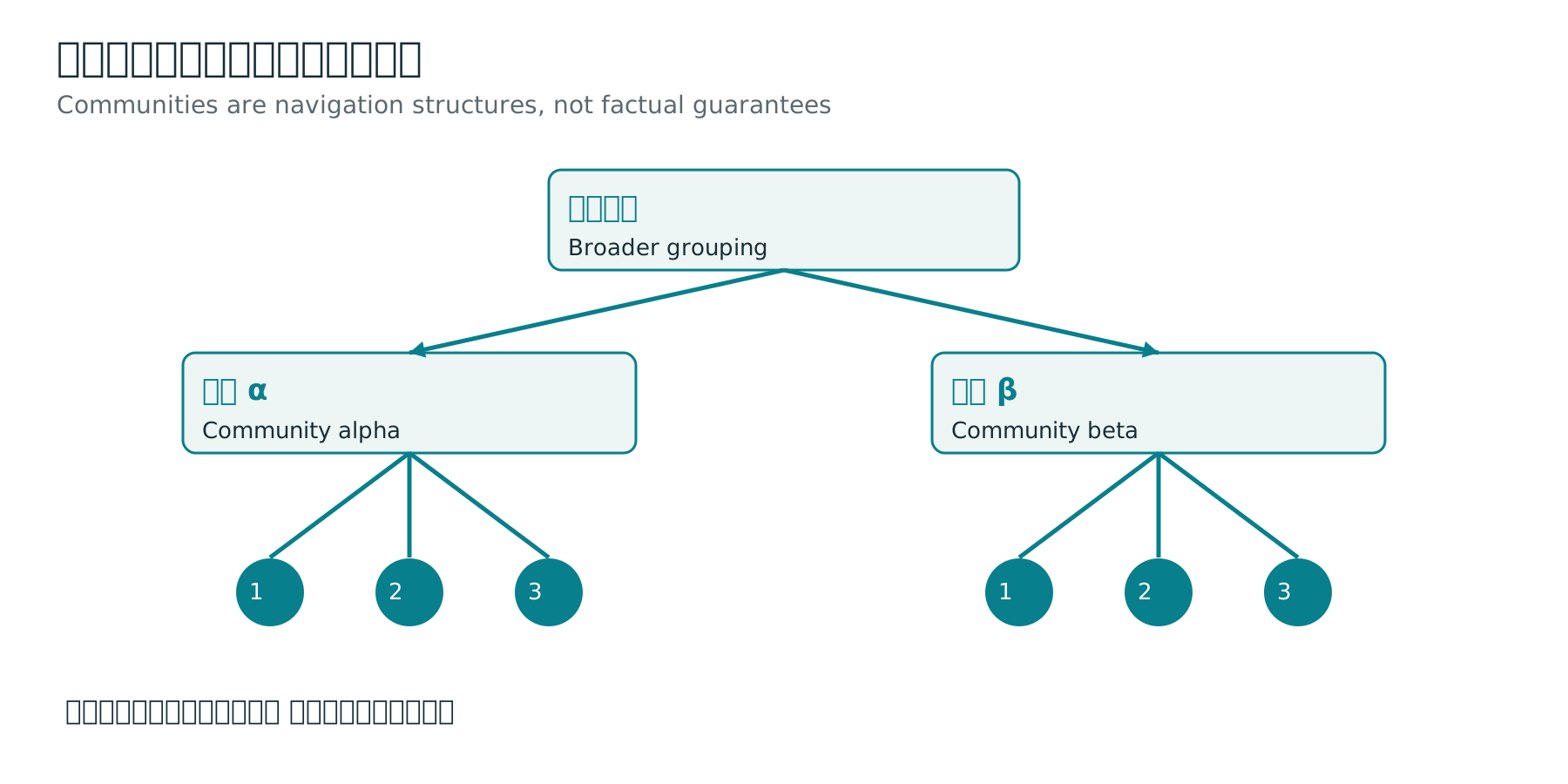
Community detection organizes nodes according to graph connections, producing groups that can be summarized. The Leiden study addresses structural properties such as community connectivity, while Microsoft GraphRAG uses communities and their hierarchy to organize summaries. A structurally well-formed community is not automatically a correct business topic. Community names and reports require linguistic interpretation, and their quality depends jointly on extraction and summarization. The graph partition, the naming of a theme, and the usefulness of that theme to a user are separate evaluation questions. [R27][R32]
We recommend retaining community membership, hierarchical relationships, and the evidence underlying each report. Changing granularity can produce a broader account or merge distinctions that matter. A topic appearing in only a few passages may not form a prominent community while remaining essential to a particular user's question. Global understanding should therefore not be equated with selecting the largest statistical groups. Evaluation should examine both topic coverage and small but relevant bodies of evidence, and state which hierarchy level supplied the reports. Community structure is a means of organizing material rather than a uniquely correct taxonomy inherent in the data. Different partitions may support different questions. Recording the chosen partition and its limitations makes the resulting analysis easier to interpret and avoids treating an algorithmic grouping as if it were an independently established organizational or causal relationship.
Schematic, no clustering run
04.4
Global Search and Batched Synthesis
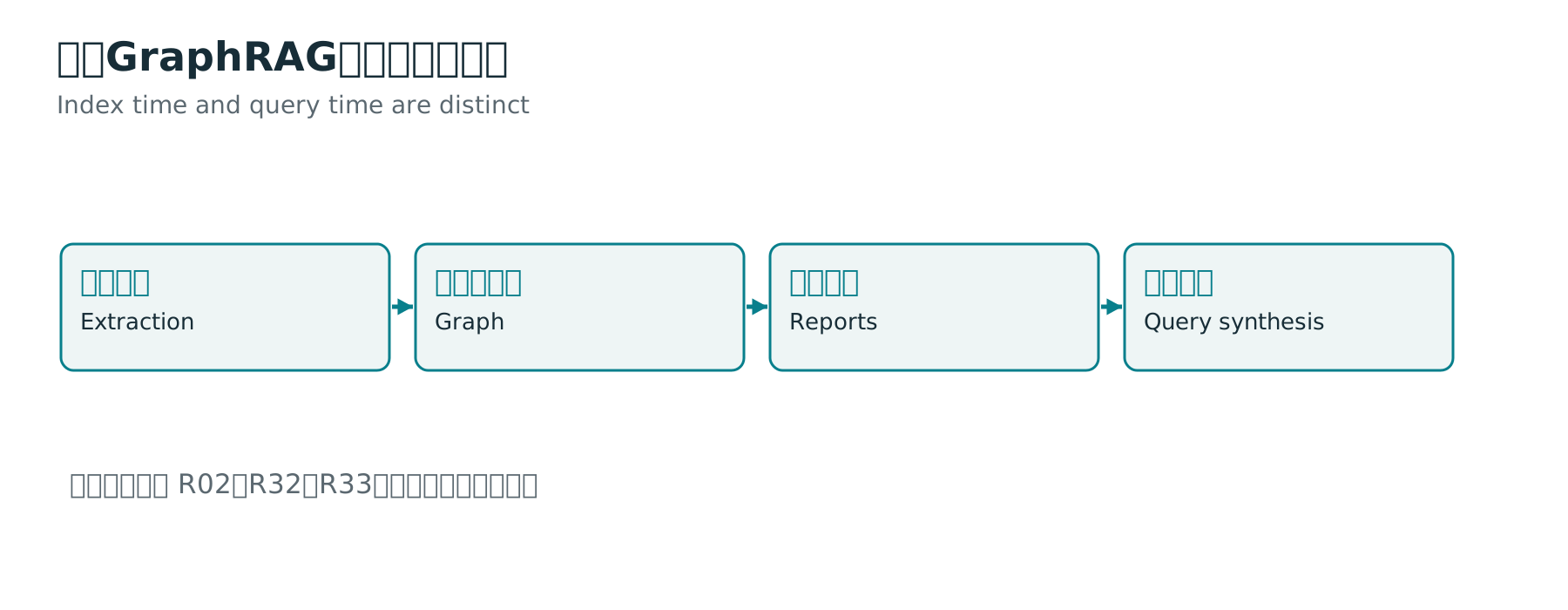
Global search uses community reports as context, generates question-specific intermediate responses in batches, and filters and aggregates them into a final response. This involves summaries created at two different times: community reports produced during indexing and intermediate answers generated for a particular query. Confusing them can create the impression that the system anticipates every future question. The official workflow explains batching and aggregation, but their effectiveness still depends on whether reports retain relevant information and whether aggregation handles repetition and differences appropriately. [R33]
We analyze global synthesis as evidence compression under a resource budget. Each layer can lose minority views, exceptions, or conflicting statements. The final answer should therefore avoid converting a summary into an unconditional claim about every item in the collection. A study can follow an important proposition through the source passage, community report, intermediate answer, and final response, examining whether its degree of certainty grows during transformation. Reports from different batches may also cite the same original source. Counting their repetition as independent corroboration overstates evidential strength. Aggregation should identify overlapping provenance and preserve meaningful disagreement rather than merge content solely for fluency. These checks explain the reliability of global summarization more effectively than answer length alone. They also make it possible to locate a failure at the layer where a qualification was lost, rather than blaming the final generator for an omission that occurred earlier.
Original design
04.5
Combining Local and Global Questions
Questions centered on a particular entity generally need detailed relationships and direct evidence. Questions about a collection as a whole require a broader account spanning several groups. An application may alternate between these requests within one conversation, for example asking about one project's partners and then asking about risks common to all projects. The design should allow local evidence and wider summaries to complement one another while preserving their distinct levels of provenance. A user who sees a global conclusion should be able to ask which specific records support it.
We recommend selecting retrieval modes according to evidential requirements rather than question length or a few keywords. An apparently specific question may require comparison across documents, while a request containing the word overall may concern only a small, identifiable set of records. Researchers can annotate the necessary evidence set and examine whether different modes cover it. If several modes run together, their costs and the rule for selecting evidence should be recorded. Passing every retrieved result to the generator may introduce conflicts and context noise rather than improve the answer. The value of a combined mode should be demonstrated through more appropriate evidence selection, not through a larger number of retrieval calls or a longer response. Comparative work motivates examining such combinations, but a routing or fusion policy still requires validation for the intended corpus and workload. [R09][R33]
04.6
Findings in the Anchor Article and Their Conditions
The early Microsoft article reports favorable comparisons on comprehensiveness, diversity of viewpoints, and support for human inspection, while reporting faithfulness to the source at a level similar to the baseline. These findings should not be rewritten as elimination of hallucination or as a universal percentage increase in accuracy. The later paper offers a more systematic analysis of global sensemaking questions, but it should be cited separately from the initial demonstration. Interpretation must retain the corpus, question-generation procedure, evaluator, and comparison system involved. [R01][R02]
The most useful implication, in our view, is a change in the unit of evaluation. When a question concerns an entire collection, similarity between the question and a few retrieved passages is insufficient. This does not remove the value of vector retrieval for explicit factual lookup. Graph construction introduces cost, latency, and additional opportunities for error, and community reports require maintenance. Adoption should depend on how often users ask associative or collection-level questions and whether the system can maintain the derived evidence. The appropriate conclusion is conditional suitability rather than treating one research method as the default answer to every knowledge task. A credible evaluation should include questions where a simpler baseline is expected to work well, as well as questions designed to expose the limitations that graph organization is intended to address. Such balance makes the boundary of a method's benefit visible and prevents selective demonstrations from becoming an exaggerated capability claim.