05.1
Compare Knowledge Organization and Retrieval Actions
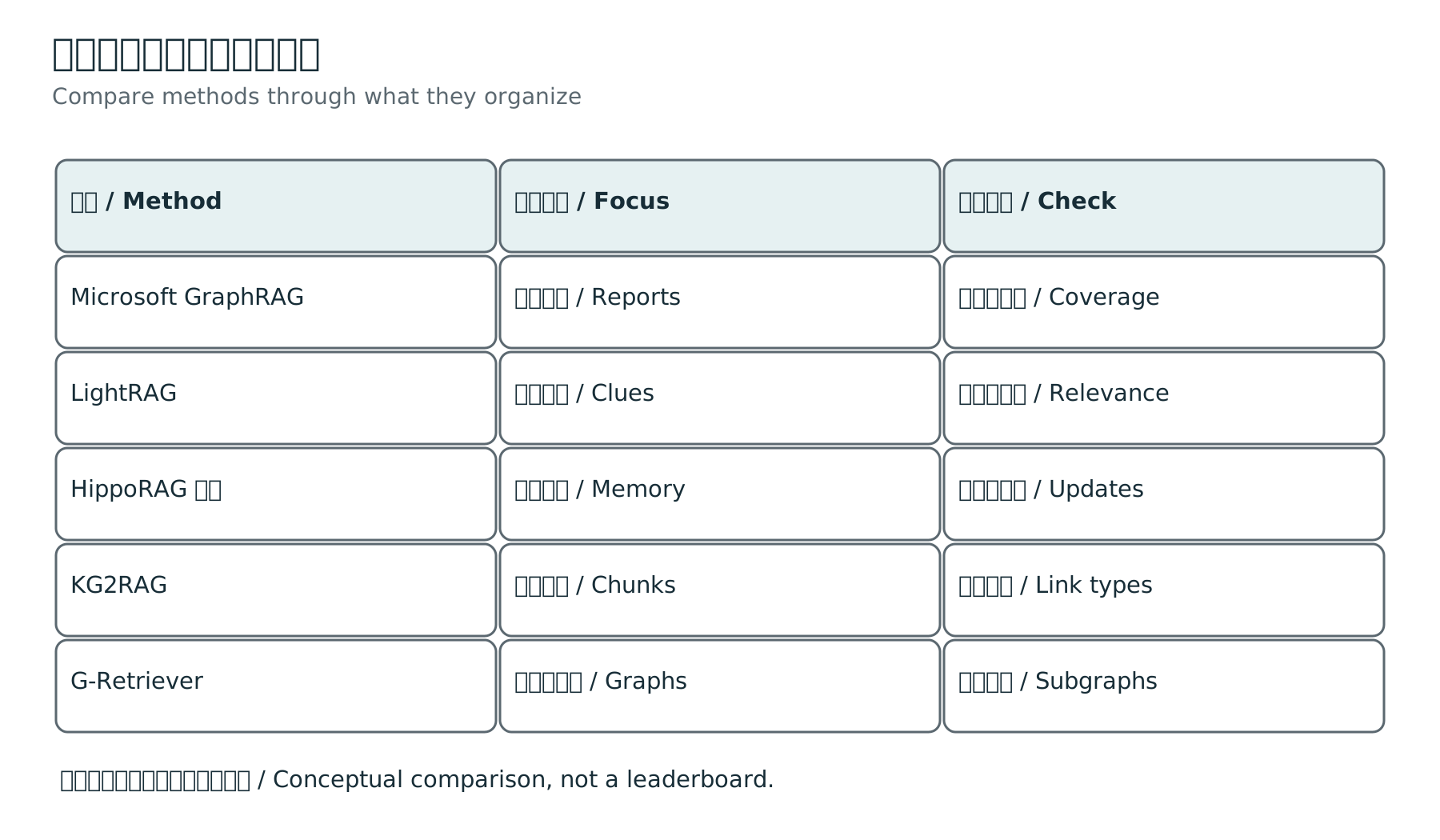
A method name is not a procurement checklist. A system called GraphRAG may extract an entity graph from text, traverse an existing business graph, or connect a graph encoder to a language model. This report proposes four concrete comparison questions: what is stored during indexing, where a query starts, which relations support expansion, and what evidence reaches the generator. These questions reveal when differently named systems perform similar work and when implementations sharing a name follow incompatible technical routes. The two surveys provide entry points into this diversity, while implementation decisions still require the corresponding paper and version.[R07][R08]
The comparison unit should be a complete configuration covering preprocessing, models, retrieval budgets, prompts, caching, and access scope. Suppose system A uses a stronger generator, more source material, and a longer context. Better answers cannot then be attributed directly to its graph. A practical selection process first establishes a reliable vector and keyword hybrid baseline, changes only evidence organization, and subsequently introduces other improvements. This sequence identifies the additional value of the graph. If the graph does not improve the target questions, the supported conclusion is that the current configuration has not demonstrated value. It does not establish that the data can never benefit from any graph method.
05.2
LightRAG and Retrieval Clues at Different Granularities
LightRAG combines graph structure with retrieval and emphasizes information retrieval at different levels. A useful reading distinguishes clues about specific objects from more abstract thematic clues. The former help locate an entity and its neighborhood; the latter help find information connecting multiple objects. Its emphasis differs from the Microsoft community report route, so these approaches should not be treated simply as faster and slower versions of one index. The words simple and fast in a paper title also cannot replace local measurements. Text length, extraction models, graph density, and update procedures all affect actual cost.[R10]
Consider an enterprise question asking why equipment A repeatedly stopped. It names an identifiable machine while also requiring an explanation of a fault pattern. A system might retrieve equipment records, fault categories, and associated work orders in parallel, then organize them by time and source. A common mistake is treating thematic similarity as event identity. Two machines experiencing high temperatures do not necessarily share one incident. Retrieval clues therefore need event, location, and temporal boundaries to prevent uncontrolled expansion. Evaluation should measure object identification, relationship coverage, and irrelevant expansion separately, and record whether the clues recover previously missing evidence. The algorithm supplies an organization of clues; the task boundaries determine whether that organization is useful.
05.3
The HippoRAG Family and Associative Memory
HippoRAG starts from a research analogy with long term memory and uses graphs and associative retrieval to organize external knowledge. HippoRAG 2 extends the discussion toward memory systems for nonparametric continual learning. Memory here is primarily an engineering organization; it does not imply human experience or a biological mechanism. The important research idea is that local similarity between a question and a single passage may miss necessary material, while association across a graph offers another discovery route. Improved long term knowledge use must still be demonstrated through explicit update and query tasks.[R11][R12]
An operational memory design needs rules for retention and forgetting. When a new report arrives, the system must determine whether it supplements an earlier conclusion, contradicts it, or describes a different period. Continually adding edges can make outdated associations easier to retrieve. Evaluation of continual learning should therefore extend beyond a static test set. It should introduce new knowledge over time, corrected facts, withdrawn sources, and repeated descriptions, then check retention of earlier tasks, acquisition of new tasks, and cessation of invalid information use. These tests turn memory into observable behavior. An auditable external memory should explain when an association entered the system, which sources support it, and when it ceased to apply.
05.4
KG2RAG and the Organization of Evidence Chunks
KG2RAG uses a knowledge graph to guide chunk expansion and organization, offering a useful example of retrieving material and then connecting it. Its broader lesson is that a graph can improve the evidence context without requiring a generator to read one large graph directly. One passage may describe equipment, another maintenance records, and a third a replacement component. Shared entities and relations can organize them into more coherent answer material. This report summarizes that methodological direction without extending particular experimental findings into a universal advantage.[R13]
Evidence organization must preserve the type of logical connection. Two passages mentioning the same supplier share an entity. A record explicitly citing another file establishes a document dependency. One incident following another establishes a temporal order. These connections support an answer in different ways. Collapsing them into untyped adjacency encourages a generator to interpret relatedness as explanation. An evidence package should therefore include the reason for each connection, source locations, and a maximum traversal depth. Direct evidence should appear before inferred paths, allowing readers to see what the sources actually state before examining how the system connects them. Even when the organization strategy fails, this arrangement makes the specific erroneous connection identifiable.
05.5
G-Retriever and Questions about the Graph Itself
Some tasks begin with an existing network whose nodes and edges carry text, and users ask directly about its objects and connections. G-Retriever studies understanding and question answering over textual graphs, reminding us that graph augmented generation is broader than Microsoft style community summaries. Existing equipment networks, citation networks, or product graphs may require selecting a relevant subgraph and presenting both structure and text to a model. Training and inference requirements for this route should be distinguished from pipelines that only call an external language model.[R14]
A larger selected subgraph is not automatically better. A connected region with thousands of nodes may contain only two relations necessary for a question, while introducing many ambiguous names and peripheral descriptions. Engineering can treat subgraph selection as evidence coverage under a budget: prioritize paths connecting key objects, sources supporting those paths, and necessary counterexamples. If a path permits several interpretations, return alternative subgraphs rather than forcing the model to choose one story. Graph distance is also not equivalent to real world importance. A short path from a weak source may be less useful than a longer chain with explicit records. Structural information must be judged together with evidence quality.
05.6
Build a Portfolio from a Task Matrix
This report recommends a task matrix rather than a brand matrix. Explicit factual questions prioritize precise localization and provenance. Relationships across documents require entity disambiguation and complete paths. Questions about corpus wide themes require coverage, synthesis, and preservation of minority views. Visual questions require checking whether image evidence is indispensable. For every task row, record the minimum viable method, the expected benefit of a graph, additional failure modes, and acceptable cost. Comparative research emphasizes that RAG and GraphRAG performance depends on task conditions; one average score cannot establish complete replacement of one approach by another.[R09]
The final system may combine several retrieval routes, but their orchestration needs an interpretable router. Determine whether a question requires global synthesis, relational reasoning, or visual identification before allocating retrieval budgets. When classification is uncertain, inexpensive candidate routes can run together and their evidence can be merged. Routing itself needs evaluation: an incorrect global route may matter more than a small improvement in the retriever. Preserve routing reasons, candidate counts, evidence origins, and fallback explanations for each request. Procurement and deployment decisions should follow utility under the real distribution of questions, rather than demonstrations on unusually complex cases. Complexity is justified when it consistently improves important tasks and the organization can maintain its additional responsibilities.
Synthesis of method directions