17.1
Clarification and representation selection template
The following templates are proposed working aids. Contexts must be replaced and outputs checked. They request inspectable definitions and evidence rather than hidden internal reasoning. Template one supports research or lesson preparation: “The problem is a specified question, the audience is a specified group, and the result should support a specified judgment. Available evidence consists of the listed sources. Constraints concern time, permission, and prior knowledge. First separate supplied facts, unconfirmed assumptions, and missing information. Then propose three suitable representations. For each, explain the question it answers, the question it cannot answer, required data, and the reason for choosing it. Mark absent information as unknown.”
An instructor can add: “The learning objective is relational explanation and transfer. Propose one learner operation for each representation rather than only a viewing activity. Do not place AI at the center merely because the topic concerns AI. State when a table is more appropriate than a complex graphic.” This connects form to cognitive purpose.
Check whether alternatives genuinely differ, whether each answers a clear question, and whether missing evidence has been invented. Ask for failure conditions if every option is presented as universally suitable. If distinctions remain unclear, narrow the task. A longer prompt cannot repair an unbounded problem.
17.2
Source to structure template
Template two converts sources into inspectable structure: “Using only the supplied material, extract concepts, actions, states, roles, and conditions. Give each a stable identifier and record its supporting location. Every edge needs a type: sequence, data transfer, dependency, classification, hypothetical influence, or authorization. Do not infer causation from adjacent paragraphs. Return element and relationship tables, three important ambiguities, and a suggested representation. Mark unconfirmed relations for checking rather than completing them from general knowledge.”
For bilingual work, add: “Chinese and English share identifiers. Preserve numbers, units, negation, scope, and uncertainty. When a Chinese term has several possible English equivalents, identify its contextual meaning before choosing. Do not create two independent factual structures.” Human review remains necessary, particularly for conditions, exceptions, and deadlines.
A student version can request a partial structure: “Provide key nodes without all connections and ask three relational questions. Do not reveal the complete structure before I answer.” An instructor may instead request a complete sourced candidate. The degree of completion follows the user's objective, keeping convenience distinct from learning.
17.3
Chart generation and computational checking template
Template three supports analysis: “Inspect field names, units, time granularity, missing values, and duplicates. List what the data cannot establish. Propose two chart forms for the question and explain their encodings and definitions. Generate an executable transformation and visualization plan, preserving original and transformed data. After execution, provide three independently reproducible points and identify prediction, imputation, or synthetic scenarios. If execution is unavailable, label the code unexecuted rather than present it as a result.”
Additional constraints can require denominators for percentages, tax and commission definitions for money, and starting points for cumulative measures. Ask the system not to smooth missing months, to distinguish conclusions from counterexamples, and to justify dual, truncated, or nonlinear axes with a more readily comparable alternative. These are observable requirements rather than a general request for rigor.
For synthetic lessons, require demonstration labels, explicit assumptions, valid ranges, and a parameter-change task. Avoid real institution names that imply field observations. Check for invented variables and scenario outputs mislabeled as forecasts. Clear captions are necessary but do not replace computational and semantic review.
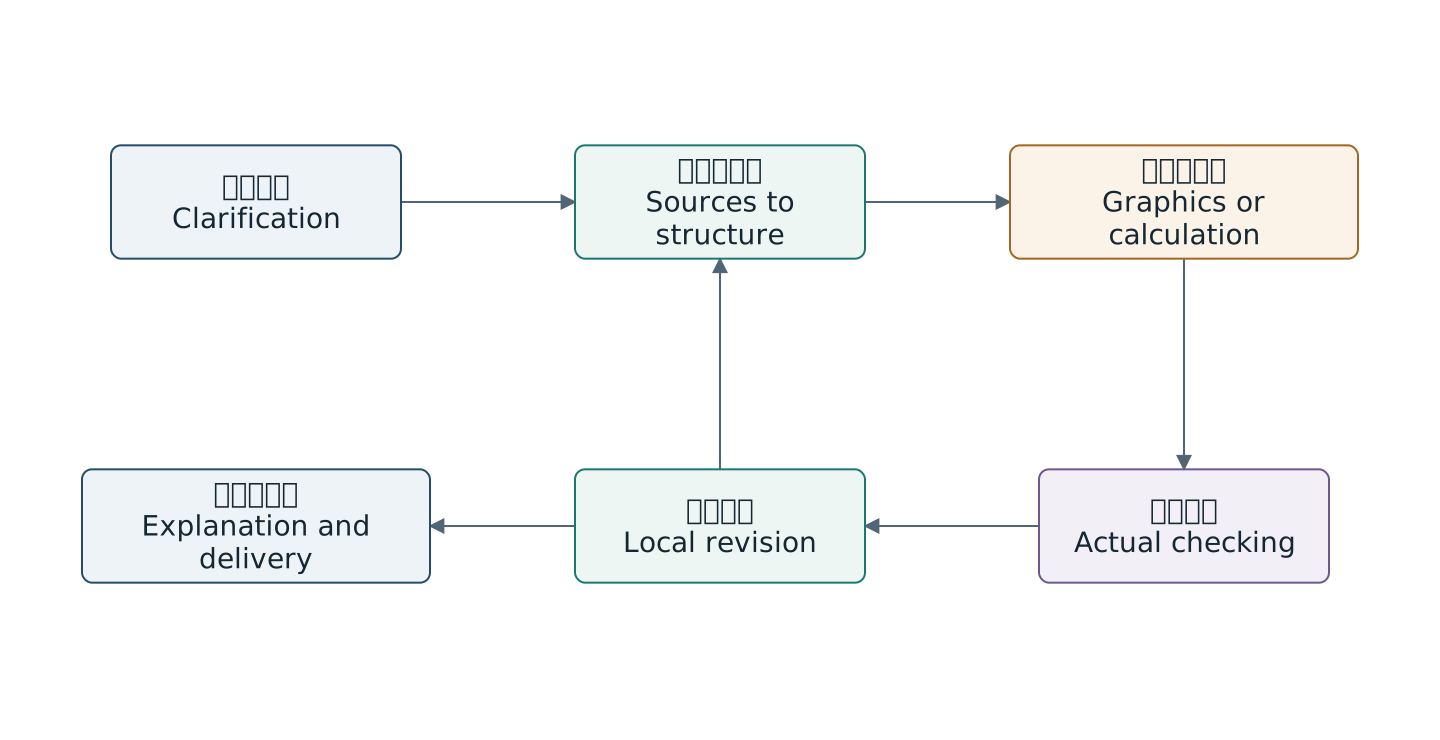
Conceptual design proposed in this report
Figures retain bilingual labels; the surrounding text explains them. Open for a larger view.17.4
Review and instructional feedback template
Template four supports review: “Inspect this visual proposal without rewriting everything. Identify specific factual, relational, quantitative, sourcing, readability, permission, and learning-alignment issues. Give the location, basis, consequence, and smallest repair. Separate confirmed errors, questions requiring confirmation, and optional improvements. Mark uncheckable items as unverified. Prioritize errors that change judgment rather than style alone.”
A learning version can first recognize one demonstrably correct structure, then ask up to three explanatory questions without revealing answers. After the learner responds, it identifies one important revision using the sources and requests a reason. Positive feedback should refer to visible performance. Instructors still check accuracy and difficulty.
A final consistency request can compare identifiers and numbers across languages, figures, tables, prose, and appendices. It should report conflicts instead of silently choosing a version and check demonstration labels, research sources, responsibility, and permissions. These templates make outputs inspectable and concentrate human confirmation on consequential relationships. They need revision through use rather than being treated as permanent formulas.
| Template | Input | Acceptance |
|---|---|---|
| Clarification | Object audience judgment constraints | Facts assumptions unknowns separate |
| Form selection | Task and available evidence | Candidates have scope and failures |
| Source conversion | Locatable sources and terms | Identifiers relations traceable |
| Quantitative chart | Fields units definitions objective | Executed and reproducible |
| Learner feedback | Attempt and learning objective | Questions elicit explanation |
| Consistency | Languages and deliverable versions | Conflicts located unknowns retained |