6.1
From producing information to framing questions
When AI can produce abundant material, scarce capabilities increasingly concern asking suitable questions, distinguishing central from peripheral information, and deciding what deserves verification. Visual thinking can transform a vague request into a problem with objects, boundaries, and relationships. Helping a hotel improve performance is too broad to guide an investigation. Mapping demand, price, channels, service costs, and guest experience makes it possible to ask whether the objective concerns short-term cash flow, contribution profit, or repeat business. Data requirements and value conflicts become visible as the problem is decomposed.
Language remains essential. Effective visual work needs accurate names, explicit boundaries, and explanations of inference. Diagrams can in turn help test the consistency of language. The important capability is purposeful movement among representations. Translating a policy into a decision table, then into a process, while identifying what each transformation loses, is more durable than simply asking a model to write a report.
Problem representation also affects organizational collaboration. Managers, analysts, and frontline staff may use the same term for different things. A shared process can require them to clarify whether customer means guest, payer, or member, and whether order means a booking record or confirmed accommodation. AI can identify possible ambiguities, but the representation gains organizational meaning only through confirmation by the people concerned. Its role is to establish a shared problem space.
6.2
Making AI recommendations open to challenge
Fluent prose can conceal inferential gaps. Turning a recommendation into a causal-hypothesis diagram, decision tree, or evidence matrix makes those gaps easier to locate. If a model proposes short-video marketing to increase occupancy, the representation should distinguish exposure, qualified visits, bookings, cancellations, and completed stays. It should also consider price, seasonality, and channel commission. An unsupported connection remains a hypothesis; an arrow must not silently promote it into a fact.
This approach externalizes an answer as an object of review. It does not require access to all of a model's claimed internal thinking. It asks for inspectable evidence, variable definitions, calculations, and differences among alternatives. A workflow graphic does not prove that a model internally followed the same process. It can document a specified system procedure or recorded tool calls. Explanatory illustrations, execution records, and claims about internal mechanisms must remain distinct.
Review also needs counterexamples. A model can propose a condition under which its advice would fail, after which people place that condition into the representation. A promotion might attract price-sensitive customers who displace higher-contribution demand. Automated service might save initial response time while delaying resolution of complex complaints. Shared structure helps a team locate the failure mechanism and a monitoring signal, rather than discuss risk only in general terms.
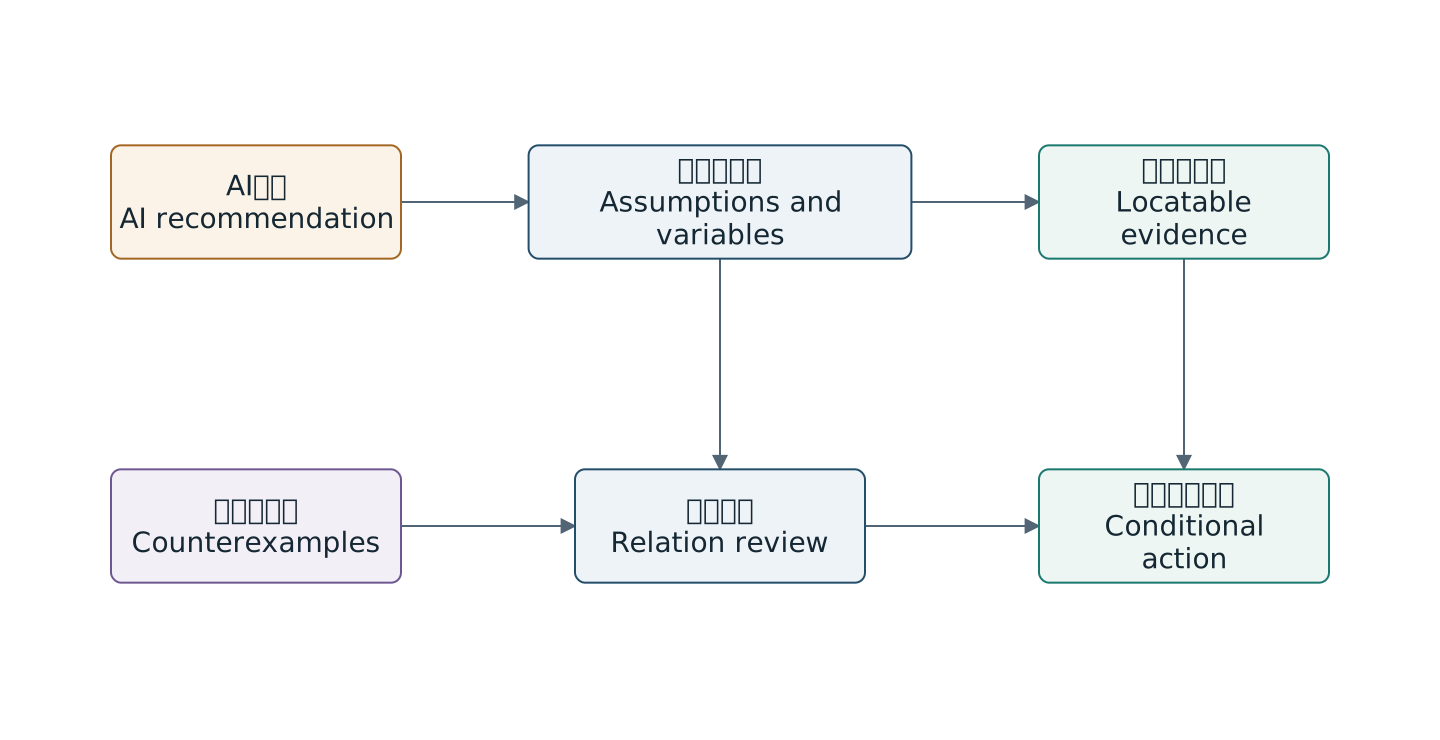
Conceptual design proposed in this report
Figures retain bilingual labels; the surrounding text explains them. Open for a larger view.6.3
Separating efficiency from thinking capability
Faster graphic production is an efficiency gain. A learner's improved ability to judge relationships is a capability gain. They may coincide or diverge. An automatically produced course map can save preparation time without ensuring that students understand its relationships. Efficiency becomes educational value when the released time supports interaction, feedback, and transfer. Evaluation should therefore record speed, correctness, and independent human performance.
Lee and colleagues surveyed 319 knowledge workers and collected 936 examples of AI use. Greater confidence in AI was associated with less self-reported critical thinking.[28] This is an association in survey data, not proof of permanent cognitive decline caused by AI. A reasonable instructional response is to require observable checks: identify a model error, justify a revision, and complete a short task without AI. Actual performance then provides evidence beyond attitudes.
Instructors also need independent judgment. Preparation time can be separated into finding material, designing structure, drawing and layout, checking facts, and rehearsal. AI may reduce some activities while increasing verification demands. Total cost should include correction and rework. Across a semester, reusable clear specifications may be more valuable than an impressive one-off generation. Students likewise need the metacognitive ability to recognize when a tool is useful and when independent work is necessary.
6.4
Designing human AI complementarity
Vaccaro and colleagues' meta-analysis covered 106 experimental studies and 370 effect sizes. On average, human–AI combinations did not outperform the better individual contributor, and results differed between content creation and decision tasks.[27] Adding a human-review node or several AI roles is therefore not sufficient. Complementarity requires explicit responsibilities, visible errors, and a method for resolving disagreement. A visual workflow makes those arrangements inspectable.
In a teaching-material system, AI might propose three representation alternatives and an instructor choose one with a reason. In a business system, the software might present evidence and scenarios before a responsible person confirms the objective. Merely pressing an acceptance button offers limited complementarity. Repeating work that a human already performs easily may also add coordination cost. Division of labor should be adjusted using actual error patterns, time records, and decision quality.
| Task | AI contribution | Human responsibility |
|---|---|---|
| Framing | Organize ambiguities and candidates | Objectives values and scope |
| Research | Find leads and extract fields | Verify sources and designs |
| Structuring | Propose relational drafts | Select and justify relations |
| Rendering | Draft code layout and translation | Check meaning and readability |
| Computation | Draft and invoke computation | Confirm assumptions and reproduce points |
| Decision | Compare scenarios and counterexamples | Own authority and consequences |