8.1 Several meanings of reasoning
Knowledge reasoning(知识推理)includes several distinct activities. Deduction(演绎推理)derives consequences from premises and rules. Induction(归纳推理)learns patterns from observations. Abduction(溯因推理)searches for explanations that could account for observations. Probabilistic inference estimates beliefs under a specified model. Causal inference(因果推断)concerns effects of interventions under causal assumptions. In graph based machine learning, “reasoning” may refer to predicting a missing edge or answering a multi hop question. The term should therefore be qualified whenever the type of guarantee matters.
The Research Evidence Graph uses separate statuses for asserted, validated, derived, and predicted statements. A derived statement has a rule and premises that explain why it follows. A predicted statement has a model and score that explain how it was ranked. An asserted statement has a source. A validated statement has passed a specified acceptance process. One statement can have several of these relationships, but the system should never silently replace one status with another.
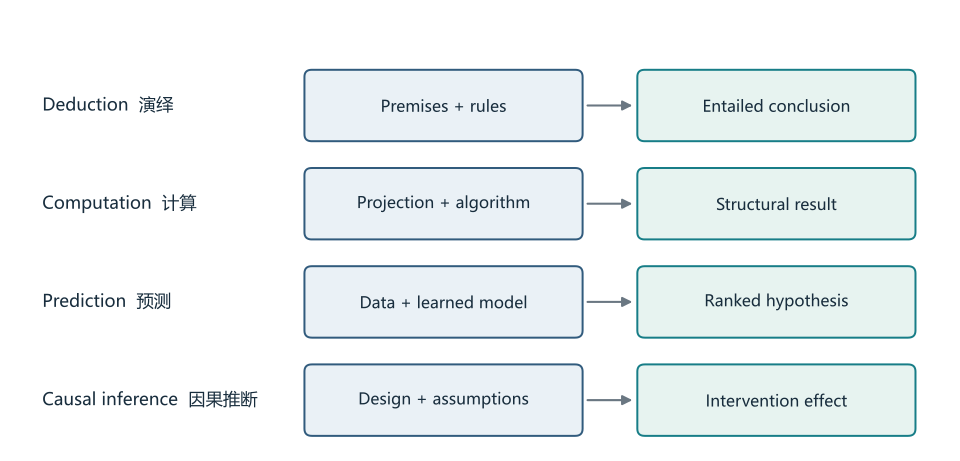
Four operations with different inputs and interpretations. A structural result or ranked hypothesis does not have the status of a logical or causal conclusion.
Original figures retain bilingual labels. Read alongside the explanation; open for a larger view.8.2 Deduction with explicit rules
Suppose the schema states that every Dataset is a ResearchResource and Dataset D is a Dataset. A reasoner can derive that D is a ResearchResource. This is a simple class hierarchy inference. A different rule might state that if a document reports an evaluation and the evaluation uses a dataset, the document has an evidence dependency on that dataset. The conclusion follows only because the application has explicitly defined this dependency rule. Ordinary graph connectivity alone does not establish it.
Rule based reasoning can be implemented by forward chaining(前向链推理), which derives consequences from available facts, or backward chaining(反向链推理), which works from a query toward supporting premises. Materialization(物化推理)stores derived results in advance; query rewriting or on demand reasoning computes relevant consequences when needed. The preferred method depends on update frequency, query patterns, and the rule language. A frequently queried stable hierarchy may suit materialization, while rapidly changing facts may make selective computation more attractive.
Every derived result should retain a justification(推导依据)or a reproducible route to one. If Dataset D is reclassified, the system must know which derived statements depend on that classification. Simply storing the derived triple without its provenance makes correction difficult. A truth maintenance process can retract conclusions whose support no longer holds, while retaining conclusions that have another valid derivation. This is a practical requirement for an evolving graph, even when the underlying rules are simple.
8.3 Open world semantics and query boundaries
Under open world reasoning, failing to prove a statement does not prove its negation. If the graph contains no record of a paper using Dataset D, the correct answer may be “not known in this graph.” A user asking “Which papers do not use D?” needs a stronger completeness assumption. The application might restrict the query to papers whose methods have been fully reviewed. It should communicate that scope so the negative result remains interpretable.
SPARQL entailment regimes specify how query evaluation can incorporate different semantics beyond simple graph matching [52]. A deployment should document whether it uses plain stored triples, RDFS consequences, an OWL profile, or custom rules. Two endpoints containing similar explicit data can return different answers because their reasoning settings differ. A reproducible query therefore needs both the data snapshot and the entailment configuration.
Closed world checks are appropriate for some operational contracts. If every accepted Evaluation is required to contain a metric, a missing metric is a validation failure within that application. This does not imply that the real world experiment had no metric; it means the stored record is incomplete under the contract. Keeping validation and logical entailment separate lets a system use both without confusing their purposes.
8.4 Rule mining and uncertain regularities
Rule mining(规则挖掘)searches a graph for recurring relational patterns. AMIE 3 improves the efficiency of mining rules from knowledge bases [27]. A mined rule can identify a useful regularity, but its measured confidence is not a logical guarantee. For example, two authors who repeatedly publish together may often share an institution, yet coauthorship does not logically imply common employment. Promoting that regularity to a strict rule would create false affiliations.
A responsible workflow separates discovery, validation, and deployment. A mined pattern first becomes a candidate rule. Domain experts assess whether it expresses a meaningful regularity or a data collection artifact. Held out data tests its predictive value. The application then decides whether to use it for suggestions, anomaly detection, or a probabilistic model. Only a relation that is justified as a logical commitment should become a hard inference rule.
Observed confidence is sensitive to missing data. If a graph records some predicates more completely than others, a rule can appear weaker or stronger because of the recording process. The system should ask what is known about completeness before interpreting a confidence score. A high score among well documented entities may not transfer to poorly documented entities. This concern connects rule mining to the broader issue of selection bias in knowledge acquisition.
8.5 Link prediction as hypothesis generation
Link prediction(链接预测)ranks missing relations as candidates for further investigation. A model may learn that certain methods are often evaluated on certain dataset families. It can then suggest a likely missing evaluation link. That suggestion is useful for finding omissions, but it does not demonstrate that an experiment actually occurred. If the target relation describes an event, external evidence is needed before the predicted edge enters the accepted factual layer.
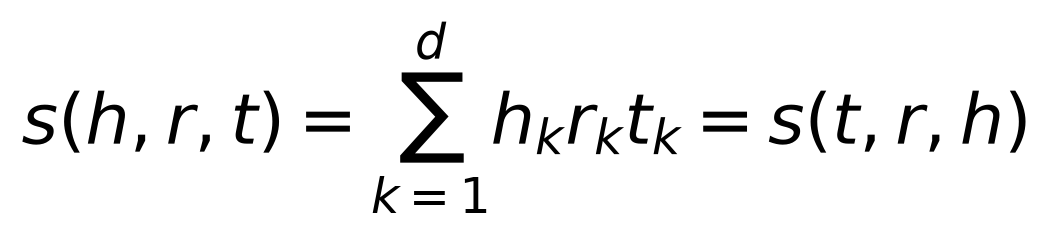
DistMult illustrates how a scoring function can impose a structural limitation. Its standard tri-linear score is symmetric in the head and tail entity vectors for a fixed relation [22]. This can be useful for symmetric patterns but cannot by itself distinguish every asymmetric relation. The observation is mathematical, not a claim that the model is universally ineffective. A deployed system may contain additional components or constraints, and evaluation must reflect the full implementation.
Negative sampling(负采样)creates candidate triples used as training negatives, often by replacing an argument in an observed triple. In an incomplete graph, some sampled negatives may actually be true but unrecorded. The training procedure therefore operates with assumptions about missingness. A research report should describe those assumptions rather than treating all absent edges as verified falsehoods. The same issue affects evaluation when a model predicts a plausible relation missing from the benchmark annotations.
Transductive evaluation(传导式评估)typically tests new links among entities seen during training. Inductive evaluation(归纳式评估)tests generalization to previously unseen entities or graphs under a defined setting. A model that succeeds in one setting may fail in the other. For an organizational graph that receives new projects every week, performance on unseen entities is a central requirement. Choosing a benchmark merely because it is popular can miss that requirement entirely.
8.6 Probability calibration and explanation
A ranking score is not automatically a probability. A model can rank correct candidates highly while producing numerical scores that poorly reflect actual correctness frequencies. Calibration(校准)studies the agreement between predicted confidence and observed outcomes; Guo and colleagues demonstrated calibration problems in modern neural networks and evaluated corrective methods [30]. In a graph application, calibration must be checked on the relevant relation types and deployment distribution rather than assumed from a general model.
An explanation should identify the actual basis of an answer. A rule based conclusion can expose premises and a rule. A retrieval answer can expose source passages. A learned prediction can expose influential paths or features, but such an explanation may be an approximation to model behavior. A path displayed after prediction is not necessarily the path that caused the prediction. The interface should label the explanation type and avoid presenting an attractive graph path as a formal proof.
8.7 Causal claims require causal assumptions
A causal graph represents assumptions about how variables influence one another. A generic knowledge graph can contain causal claims, but it does not become a valid causal model merely by labeling an edge CAUSES. Causal inference requires a defined intervention question, assumptions about confounding and structure, and an identification or estimation strategy [50]. A centrality measure or an association pattern cannot substitute for those requirements.
In the research example, papers reporting that a method improves an outcome provide evidence about a claim. Whether the claim is causally supported depends on study design, comparison conditions, and alternative explanations. A graph can organize those features and retrieve relevant evidence. It cannot repair an uncontrolled comparison simply by connecting it to other studies. This limitation should appear near any causal interpretation, especially when an agent summarizes mixed experimental and observational evidence.
8.8 A practical reasoning architecture
The proposed architecture routes questions to the appropriate operation. Exact factual questions use accepted assertions and sources. Taxonomic questions use a configured deductive layer. Exploratory discovery uses rankings and predicted links clearly labeled as hypotheses. Causal questions retrieve study designs and assumptions for a separate analysis. This routing can be implemented through templates and typed tools before introducing an elaborate autonomous planner.
The answer record contains the operation type, input snapshot, evidence, uncertainty, and any rules or models used. If the system cannot satisfy the required evidence standard, it returns an incomplete answer or asks for a narrower question. This behavior preserves the usefulness of the graph without assigning every output the same authority. The central design principle is that the status of a conclusion should remain visible from its production through its presentation and any subsequent action.