19.1
From a reading list to a question structure
Visual thinking can organize research reading, but an author or keyword network does not replace understanding a question. Researchers need to distinguish theoretical claims, measures, interventions, outcomes, and inferential limits. AI can extract fields from English abstracts into an evidence matrix. Researchers then check important originals and decide which studies are comparable. The map reveals differences and gaps rather than forcing all papers into one conclusion.
Drawing after reading, observing an instructor draw, manipulating computer shapes, and receiving an AI-generated diagram are different interventions. Recall, comprehension, and transfer are different outcomes. A single visual-learning-is-effective node erases those distinctions. A useful evidence map encodes intervention, comparator, support, and measurement separately, showing which relationships have repeated evidence and which remain theoretical.
AI extraction should preserve provenance and uncertainty. If random assignment is not described, it remains unspecified. If no delayed test appears, a long-term effect must not be invented. A system can identify missing information most likely to change interpretation, helping researchers prioritize full-text reading. Summary convenience should support close reading rather than replace it.
19.2
Avoiding manufactured consensus in evidence maps
Evidence maps should accommodate support, unclear differences, mixed findings, and boundaries. Color needs labels and definitions. Edge width representing study count must not imply quality. Node size representing sample size must not automatically imply causal strength. One explicit meaning per encoding is easier to review than several visual properties jointly suggesting importance.
A 2025 study record on combining drawing with retrieval practice reports no overall superiority of a closed-then-open-book arrangement and discusses a trade-off involving retrieval and mental-model quality.[40] Combining two plausible strategies does not necessarily improve learning. An evidence map can separate the proposed mechanisms and generate further questions instead of treating an unclear advantage as a simple failure.
AI-assisted visual research should similarly retain counterexamples and costs. Accuracy may improve while time increases; novice products may improve without independent explanation; spatial tasks may benefit while classification does not. Making conditionality visible is the map's purpose. A diagram in which every path converges on a general AI-success claim deserves scrutiny for selective presentation.
19.3
Connecting theory and measurement
A study model can separate intervention, process, outcome, and background. Question-based AI feedback is an intervention; relational revision and self-explanation are possible processes; transfer is an outcome; prior knowledge and language familiarity are contextual conditions. Arrows remain hypotheses. Each concept also needs an observable measure if the model is to guide collection.
AI can propose alternatives. Better performance may reflect more time, clearer prompts, or novelty rather than visual feedback alone. Adding these possibilities helps design comparisons. A model can also generate a strong objection for researchers to test against the design. It supplies candidates; methods and evidence determine adequacy.
Conceptual and statistical displays should correspond. A relationship claimed as tested needs an identifiable analysis, while unmeasured mechanisms remain speculative. A visual index connecting questions, variables, analyses, and conclusions helps prevent discussion sections from expanding beyond the evidence and helps reviewers locate the argument.
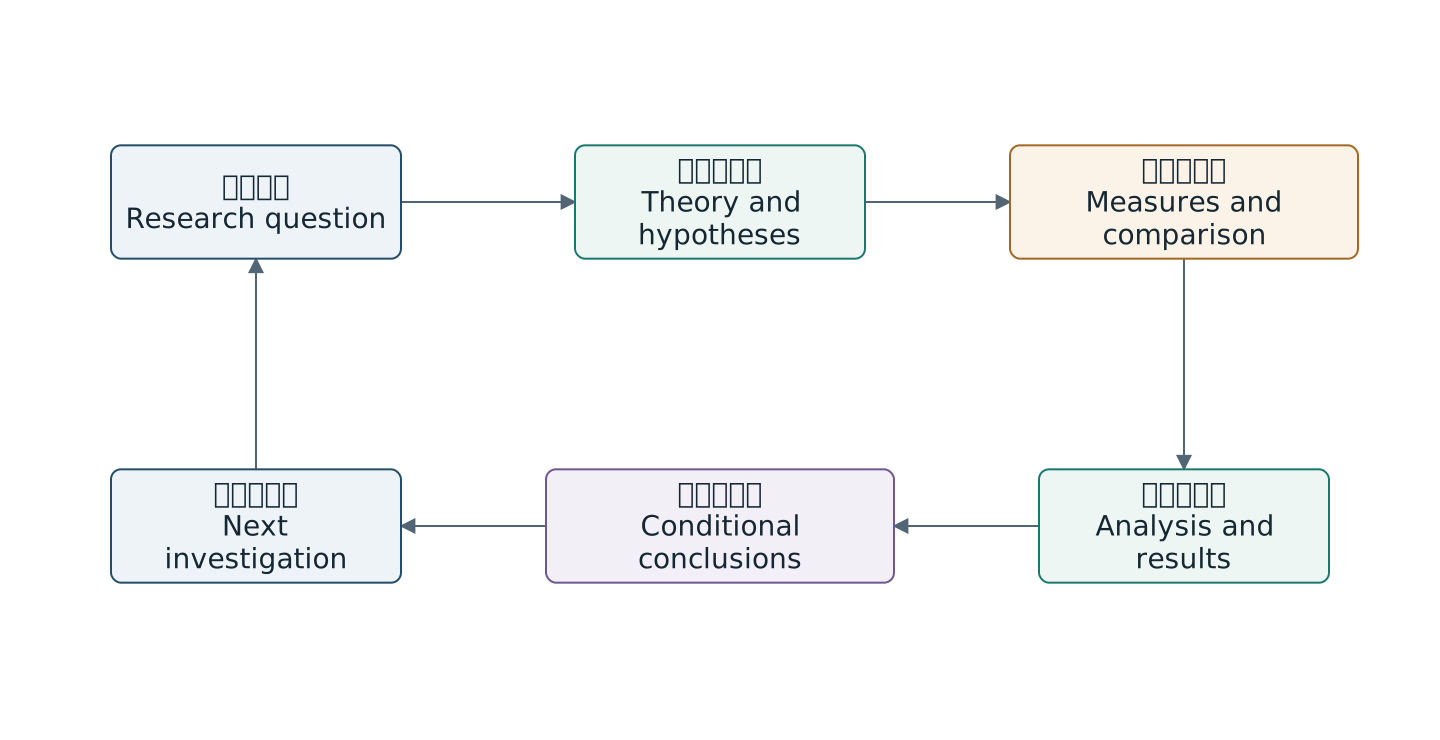
Conceptual design proposed in this report
Figures retain bilingual labels; the surrounding text explains them. Open for a larger view.19.4
Division of work in English language research
English-language research can be organized into discovery, screening, verification, synthesis, and writing. AI and scholarly tools broaden leads, summarize abstracts, and identify terminology. People check source identity, design, context, and strength. Searches should combine conceptual, task, and methodological terms rather than rely on one popular phrase, which may miss related traditions.
Before citation, verify title, authors, year, and publication status. Online and issue dates may differ, preprints change, and discovery services can disagree. This report uses the formal 2020 issue year for the drawing meta-analysis while noting first online publication in 2019, avoiding duplicate treatment. Such checking belongs in student scholarly competence.
Synthesis should follow a question structure rather than translate abstracts sequentially. Organize around tasks, mechanisms, boundaries, implementation, and validation, separating evidence from recommendations. Bilingual conclusions need equal strength: a Chinese statement of possibility must not become an English claim of proof. This detail directly affects credibility.
| Field | Record | Error |
|---|---|---|
| Publication status | Year version and status | Counting versions as new studies |
| Design | Experiment survey review prototype | Demonstration treated as learning evidence |
| Intervention | Who performs which visual operation | Conflating AI and learner generation |
| Comparator | Time guidance and materials | Ignoring weak comparisons |
| Outcome | Retention comprehension transfer time | Product quality replaces capability |
| Limits | Sample task and accessible evidence | Inventing absent details |