20.1
From sketches to discussable prototypes
In product, spatial, and service design, sketches make uncertain ideas available for discussion. Roughness can be useful because it signals that change remains possible. AI quickly generates layouts, interfaces, and situations, broadening comparison. Premature realism can nevertheless imply that cost, structure, and feasibility are settled. A prototype should communicate its level of completion.
Sutherland's Sketchpad demonstrated the potential of graphical interaction and constraints in computer-aided work decades ago.[19] Contemporary AI adds language interaction and candidate generation without replacing constraints. A lobby rendering still needs checks on movement, dimensions, and operating requirements. A service interface still needs data and permission checks. Generation belongs inside a constrained process.
Students can sketch a low-fidelity interface and identify the decisions users must make before asking AI for two visual alternatives. They compare task completion before style. An attractive version that removes an important explanation needs revision. Design quality then concerns purpose, constraints, and experience together.
20.2
Shared graphics across organizational roles
Shared graphics provide a reference across professional roles. Business staff explain objectives, analysts explain fields, developers explain implementation, and managers explain responsibility. Shared reference does not require identical interpretation; it makes disagreements locatable. Someone who objects to a process can identify a node, edge, or rule and provide a basis for change. Discussion becomes a tractable difference rather than a general opinion.
An AI meeting assistant may draft diagrams and decision records, but it must distinguish proposals, agreements, and unresolved disagreements. Repetition does not establish consensus, and silence does not establish approval. Confirmation states require explicit records. Important changes need ownership and follow-up so that the diagram does not become an attractive summary without responsibility.
Layered views support different needs. Managers inspect objectives and risks, implementers inspect interfaces and data, and frontline staff inspect actions and exceptions. Shared identifiers connect these levels. AI can produce views while common semantics and change control remain organizational responsibilities.
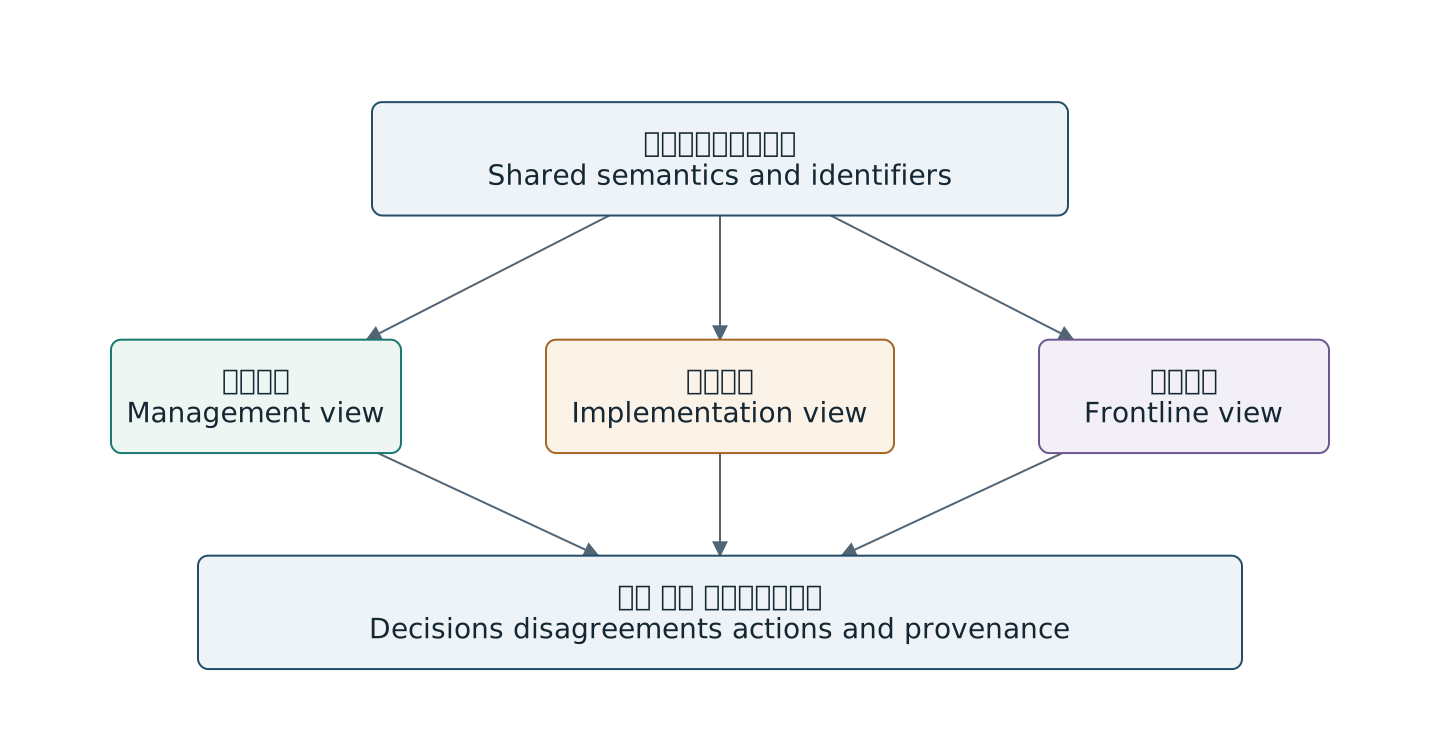
Conceptual design proposed in this report
Figures retain bilingual labels; the surrounding text explains them. Open for a larger view.20.3
The rhythm of divergence and convergence
Creative work needs expansion and selection. AI can propose unusual combinations and alternative perspectives, while a visual workspace keeps candidates side by side instead of losing them in chat sequence. Convergence then uses prior criteria for value, feasibility, risk, and cost. Endless new images can increase material without enabling progress.
Keep a manageable set and record a distinctive benefit and weakness for each. Visual difference is not necessarily conceptual difference: three colors of one process are not three solutions. Alternatives may change service timing, responsibility, data use, or user choice. Asking AI to describe structural differences before drawing reduces dependence on novelty.
Convergence can combine supported parts or return to a rejected option when conditions change. Any hybrid needs consistency checks. Preserved alternatives and reasons give the process memory. Visual thinking supports imagination and the decision to stop exploring and begin testing.
20.4
Organizational learning and maintenance
Teams should retain problem patterns, judgment rules, and failures alongside templates. An archive can contain the question, main representation, evidence, revised assumptions, and outcome. AI retrieves related experience and proposes candidates, but a previous solution does not automatically fit a new context with different customers, permissions, timing, or resources.
Representations can lose contact with operations after role, system, or policy changes. Important workflows need ownership, versions, and review triggers. Review should follow meaningful changes rather than require constant redrawing. Materials used to train staff particularly need to describe current practice rather than an old idealized plan.
Useful measures include onboarding time, ability to locate cross-department problems, traceability of errors, and synchronization of revisions. These are closer to organizational value than the number of graphics produced. Capability appears when a team can establish shared understanding and revise action as evidence changes.
| Object | Required explanation | Maintenance |
|---|---|---|
| Proposal | Who proposes and on what basis | Keep pending confirmation |
| Agreement | Which roles explicitly agree | Record decision and date |
| Disagreement | Node edge or rule conflict | Record evidence and resolver |
| Action | Owner deadline authority | Track execution and outcomes |
| Assumption | When it may fail | Define tests and review triggers |
| Experience | Applicability and limits | Recheck fit before reuse |