21.1
Beginning with a minimal viable workflow
Deployment can begin with one confirmed source, one representation, one check, and one user. An instructor might provide a policy page, receive extracted conditions and a decision table, verify it, and turn it into an exercise. This minimal flow can test structural reliability before several platforms, roles, and publication mechanisms are connected. Complexity should grow with demonstrated need.
Success means more than file creation. The file must open, relationships must match the source, the audience must understand it, and the task must work. Failure may concern recognition, semantics, rendering, translation, or use. Short stage records prevent every problem from being attributed to insufficient model intelligence. Unclear evidence, unsuitable form, and interface problems require different repairs.
Classroom deployment can begin with instructor review before release and gradually enable learner generation. Sources, versions, and revision scope should be visible, with access back to evidence. The system suggests while learners retain explanatory duties. The minimal flow remains a fallback and quality baseline as automation expands.
21.2
File structure and versions
A maintainable project separates sources, semantics, data, graphics, manuscript, and validation. Sources retain original versions, semantics store nodes and edges, data include inputs and transformations, graphics include editable sources and exports, and validation records checks and findings. Stable identifiers connect outputs instead of relying on memory or repeated final-version filenames.
Changes should distinguish facts, structure, and style. A factual correction may require reanalysis. A structural correction may update manuals and assignments. Styling primarily affects presentation. Releases record scope and review requirements. Bilingual materials especially need common facts and chart data. Ambiguity discovered during translation should be repaired conceptually rather than silently reinterpreted in English.
Backups must support restoration. Sources without fonts, data, or rendering information may not reproduce an artifact. A brief reproduction note records inputs, process, outputs, and limits. Another student should be able to reconstruct important graphics. This turns visual work into maintainable knowledge.
21.3
Software selection and replaceability
Software selection can compare coverage, precision, editability, provenance, collaboration, accessibility, cost, and export. Structural drawing, charting, image generation, and interactive computation serve different needs. One product should not automatically carry every task, and a currently popular tool should not become the only long-term foundation. Learners need selection and validation principles.
Wolfram's Manipulate and Graph illustrate a route combining symbolic computation, interaction, and relational display.[36][37] Other suitable tools may serve similar objectives. Licensing, learner environments, maintenance, and output requirements matter. Offline use, Chinese fonts, and mobile reading should be tested with real examples rather than inferred from a feature list.
Replaceability follows from separating semantics and presentation. Clear structures and data allow a renderer or export format to change. Logic trapped in an uneditable picture raises migration cost. Requiring both a source structure and an exported figure makes replaceability a practical student habit.
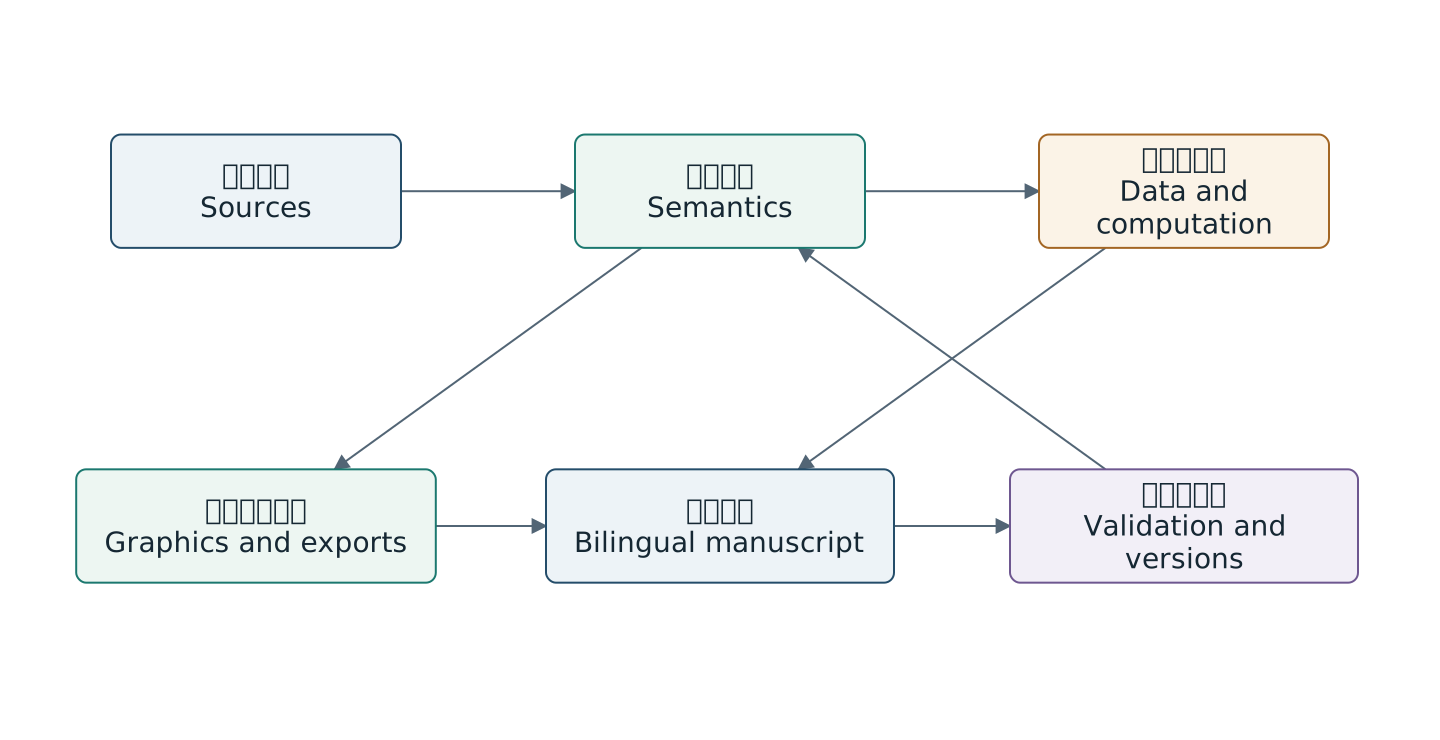
Conceptual design proposed in this report
Figures retain bilingual labels; the surrounding text explains them. Open for a larger view.21.4
Feedback and revision in use
Daily feedback should identify a task-specific issue: an unclear relation, disputed rule, failed operation, or unreproducible result. General satisfaction is supplementary. Element identifiers help users locate a problem and maintainers assess its consequences. Related outputs update together, while older versions are marked to prevent continued use.
Small manual audits can inspect sources, numbers, bilingual consistency, and exceptions. Sampling cannot prove universal correctness but can expose recurring problems. Repetition should trigger changes to input requirements, intermediate structures, or validation rather than only local repairs. The environment then learns from use.
Individuals can retain one independent check per task: recompute a point, test an exception, or revisit a source passage. These modest habits reinforce the status of output as a candidate and understanding as an active responsibility.
| Category | Content | Purpose |
|---|---|---|
| Sources | Versions dates access | Check facts and applicability |
| Semantics | Nodes edges confirmation | Share across languages and views |
| Data | Inputs transformations parameters | Reproduce and inspect |
| Graphic sources | Specifications and exports | Replace renderer and revise |
| Manuscript | Citations graphics interpretation | Support audience judgment |
| Validation | Reviewer time findings repairs | Locate quality and ownership |