22.1
Investigating night time complaint delays
A simulated hotel reports longer complaint resolution at night. Students receive de-identified events, staffing, and simplified policies. They first map current practice without immediately recommending AI. Receipt, first response, handoff, and resolution times must be distinguished, including events crossing midnight. A variable dictionary precedes timelines and responsibility diagrams.
AI then proposes explanations such as concentrated demand, delayed handoff, and limited authority. Students list support, counterevidence, and gaps for each. Plausibility does not establish a cause. They choose a testable improvement, explain its mechanism, measures, and side effects, and test an unseen exception.
Assessment focuses on definitions, temporal measures, and links between evidence and intervention. A justified conclusion that more evidence is needed can be successful. The exercise develops judgment under uncertainty rather than requiring every task to end in a success story. AI supports candidate comparison without replacing observations.
22.2
A graphical audit of marketing claims
The second exercise supplies a simulated AI marketing report with deliberate problems: exposures confused with people, cumulative values confused with period values, conversion without denominators, correlation presented as causation, and optimistic scenarios alone. Students first mark issues independently and then discuss the smallest consequential repairs.
After revision, they rewrite the conclusion. More orders during a campaign do not alone establish incremental effect. Missing cost prevents a profit claim. Falling completed stays require a different interpretation of rising bookings. AI can propose replacement charts, but definitions must remain stable. A peer who did not create the figure then explains it as a comprehension check.
A bilingual audit can add revenue translated as profit or an estimate qualifier omitted from Chinese. These are content differences rather than stylistic choices. Visual form, quantity, and language jointly determine interpretation.
22.3
Stress testing a course generation skill
The third exercise evaluates a visual-course generation specification with insufficient sources, conflicting policies, quantitative tasks, and varied learner backgrounds. Reviewers observe clarification, uncertainty, representation choice, and human checks. A specification needs interpretable behavior under difficult conditions as well as smooth demonstrations.
A deliberately strong rule might require every item to become a graphic, exactly nine slides for ninety minutes, and complete automation. Reviewers identify conflicts involving density, activity time, accessibility, and precision. They replace rigid rules with defaults, exceptions, and acceptance criteria. AI proposes counterexamples while a course owner confirms the specification.
The report retains one rule, revises another, and leaves one unresolved with reasons. Without usage records, it cannot claim a measured efficiency gain. A proposed trial is appropriate. The task develops the ability to convert aspirations into testable commitments and evaluate automation claims.
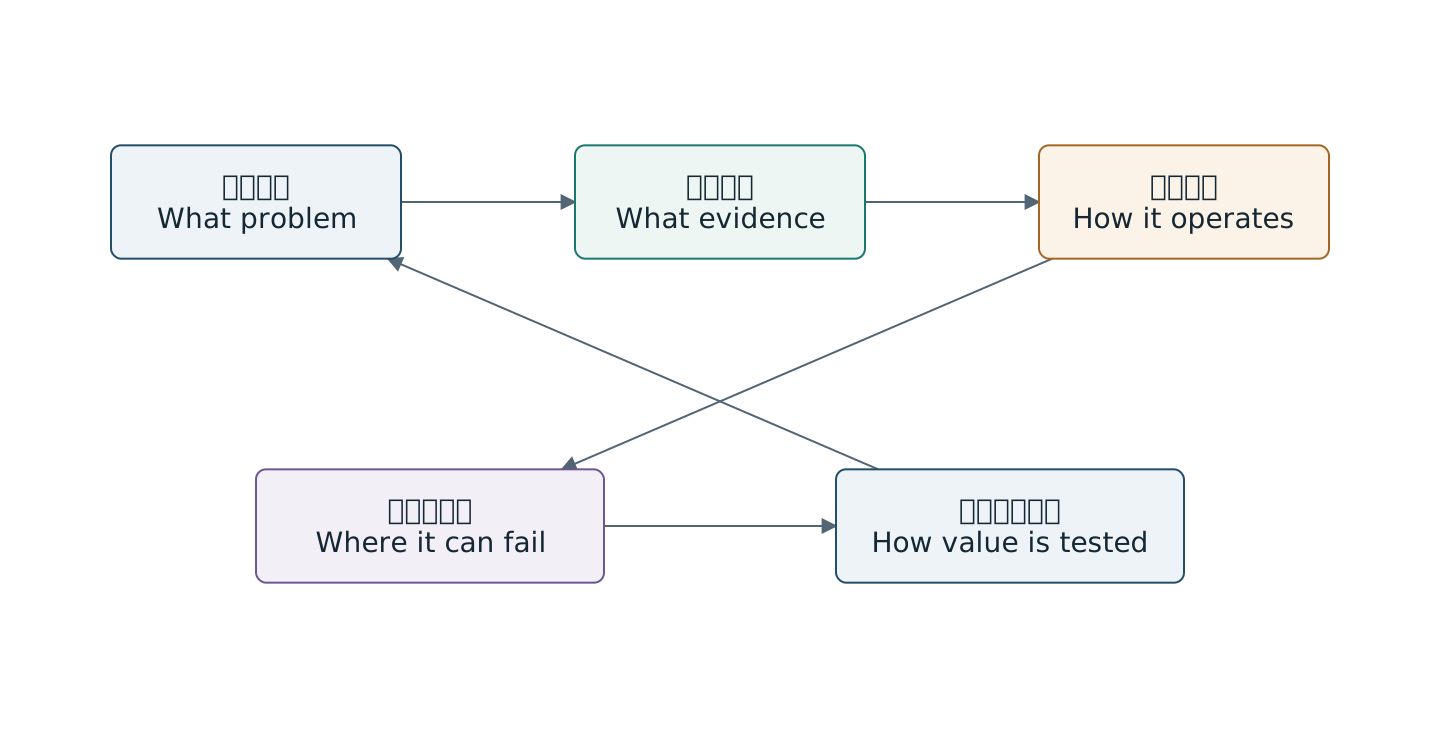
Conceptual design proposed in this report
Figures retain bilingual labels; the surrounding text explains them. Open for a larger view.22.4
Organizing an integrated defense
A ten-minute defense can devote two minutes to the problem and evidence, three to the principal representation, three to changed conditions, and two to AI's contribution and limits. Submitted materials include a problem map, evidence table, workflow, validation, and revisions. A reviewer probes a consequential relationship so that fluent presentation alone is insufficient. Timing can change while independent explanation and transfer remain.
Assessment should not equate eloquence with competence. Pointing, annotation, or short writing can provide alternative access with appropriate time. Relationships, evidence, and justified revision remain central. Different group members answer different questions, supplemented by individual assessment. Tool declarations concern relevant work rather than private unrelated content.
The final project answers five questions: what problem, what evidence, how it operates, where it can fail, and how usefulness will be assessed. Visual thinking supplies shared structure, AI lowers construction and comparison costs, research methods constrain conclusions, and people retain explanation and validation. This combination can continue across changing products and supports industry problem solving.
| Case | Task | Key test |
|---|---|---|
| Night complaints | Current map and time definitions | Keep hypotheses separate |
| Marketing audit | Locate and repair errors | Revise conclusions with evidence |
| Skill testing | Difficult inputs and revised rules | Defaults and exceptions explicit |
| Revenue scenario | Change and explain parameters | Separate computation and validity |
| Bilingual review | Compare numbers conditions terms | Preserve uncertainty and negation |
| Individual defense | Explain an edge and new context | Understanding beyond group assistance |