3.1
Externalizing relationships from working memory
Remembering the handoffs among reception, housekeeping, revenue management, and guest service creates a burden that concerns both the number of components and the need to maintain their relationships. Moving those relationships into an external display lets people recover information through position and marking, reducing repeated memory search. Larkin and Simon's classic analysis shows how informationally equivalent prose and diagrams can differ in computational efficiency because they support different search and inference operations.[3] This explains a possible advantage of diagrams without guaranteeing an advantage for every graphic.
A classroom exercise can make the mechanism observable. Students first read a description of a complaint procedure with six handoffs and identify a possible gap in responsibility. They then inspect a diagram containing the same information and explain how they locate the gap. The instructor observes looking, revisiting, and explaining rather than simply asking which version looks nicer. Two simple actions may need only a sentence. A diagram with twenty arbitrary colors may increase search effort. The benefit depends on the match between organization and task.
External representations also preserve a history of thinking. An assumption written beside a diagram can later be compared with data. A node marked for verification does not have to remain in someone's memory. This visible temporary workspace is particularly valuable when AI supplies many candidates quickly. People need to distinguish proposals from checked claims. The workspace should therefore accommodate uncertainty, incomplete work, and rejected explanations, as well as polished answers.
3.2
From selection and organization to integration
The cognitive theory of multimedia learning emphasizes selecting relevant information, organizing verbal and pictorial material, and integrating it with prior knowledge.[8] Learners are not passive recipients of whatever appears on a screen. For AI-generated instructional materials, the design question should therefore extend beyond which image belongs on a slide. It should identify which pieces of information the learner must connect. In an explanation of retrieval-augmented generation, a retrieval diagram needs a meaningful correspondence with an actual hotel-policy excerpt. Otherwise, students may remember component names without understanding how evidence constrains an answer.
One activity asks learners to attach evidence markers to the process. Where is the date condition in the question preserved? How does a retrieved passage enter the context? Which sentence in the response is supported by which policy? The instructor then replaces one policy and asks which elements must change. Integration becomes observable, and the activity exposes the mistaken assumption that a generated diagram means completed understanding. AI can suggest correspondences, but learners must justify and correct them.
Timing also matters. Showing a complete diagram and reading it aloud may leave students passive. Alternatives include predicting a missing node before the reveal or identifying contradictions between two representations. Learners with limited prior knowledge may need a partial structure and constrained choices. More advanced learners can work with reduced prompts. Scaffolding should enable valuable cognitive work and gradually release responsibility, rather than permanently perform the work on the learner's behalf.
3.3
Manipulation as an epistemic activity
Kirsh and Maglio's account of epistemic action shows why some apparently additional external actions help people discover solutions rather than merely execute decisions already made.[17] Moving nodes, regrouping items, drawing an auxiliary line, or adjusting a parameter can change what becomes visible in a problem. An interactive representation can therefore act as a device for generating questions as well as a medium for presenting answers.
Moving a complaint-handling node to a position before arrival may expose a temporal inconsistency. Placing housekeeping and check-in in one responsibility lane may reveal an ambiguity about ownership. The movement does not prove that a procedure is correct, but it creates a need for explanation. A well-designed AI workspace should ask what relationship changed, what justifies that change, and which other elements are affected. Without such questions, interaction can become arbitrary rearrangement.
Parameter manipulation similarly makes an abstract equation observable, but it can create a false sense of validation. A curve that changes immediately after a slider moves confirms the behavior of the programmed model, not the behavior of the world. Instruction should repeatedly distinguish exploration within assumptions from testing assumptions against new observations. The former asks what follows if a model is accepted; the latter asks whether it should be accepted. Recognizing this distinction is a central component of mature visual thinking with AI.
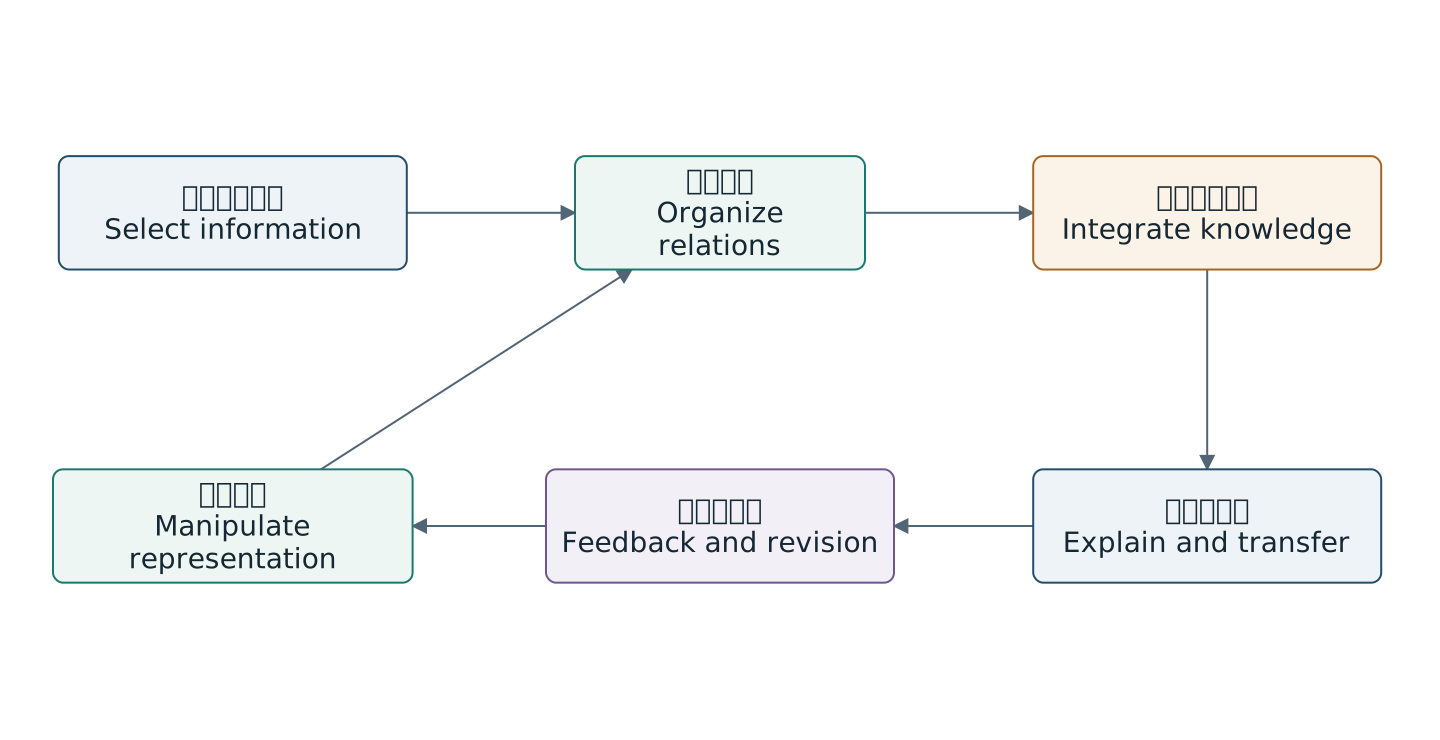
Conceptual synthesis not a measured causal model
Figures retain bilingual labels; the surrounding text explains them. Open for a larger view.3.4
Bringing individual differences into instruction
Research on object, spatial, and verbal processing supports discussion of individual differences along specific dimensions.[4][5] Preferences, abilities, and learning outcomes nevertheless require separate measurement. Liking pictures does not establish competence in interpreting a statistical chart. Feeling confident in spatial imagery does not imply knowledge of hotel operating rules. Pashler and colleagues' evidence review did not establish a general learning benefit from matching instructional form to assessed learning style.[6] A course can recognize differences without turning them into fixed educational destinies.
A more defensible design offers a common objective, several entry routes, and shared criteria for success. Learners may begin by speaking, sketching, or listing, but all must eventually explain relationships, evidence, and limitations. A meta-analysis of spatial-skill training supports the view that these skills can develop rather than simply function as inherited labels.[7] Visual representational competence should therefore receive sustained practice, instead of a beginning-of-course questionnaire deciding who should use pictures and who should use prose.
Support should address concrete barriers. Color discrimination, small print, complicated layouts, working-memory demands, and interaction devices can create different problems. Appropriate responses may include alternative text, enlargement, progressive disclosure, keyboard access, or additional time. Autism, attention differences, or imagery differences alone cannot determine the right representation for an individual. The instructor and learner should examine actual task performance and adapt access while preserving the central learning objective.
| Dimension | Evidence | Support |
|---|---|---|
| Representation knowledge | Interpret symbols and edges | Model conventions and limit vocabulary |
| Domain knowledge | Explain operating rules | Connect cases with sources |
| Spatial experience | Perform defined spatial tasks | Progressive practice and feedback |
| Language familiarity | Understand terms and conditions | Glossary and plain expression |
| Perception and interaction | See and operate the material | Text alternatives and keyboard access |
| Confidence and judgment | Compare certainty and accuracy | Independent checks and counterexamples |